Three thousand kilometres on a Himalayan 450.
Three months in. What works, what slips in the mud, and the gear-five-to-six transition that won’t stop annoying me.
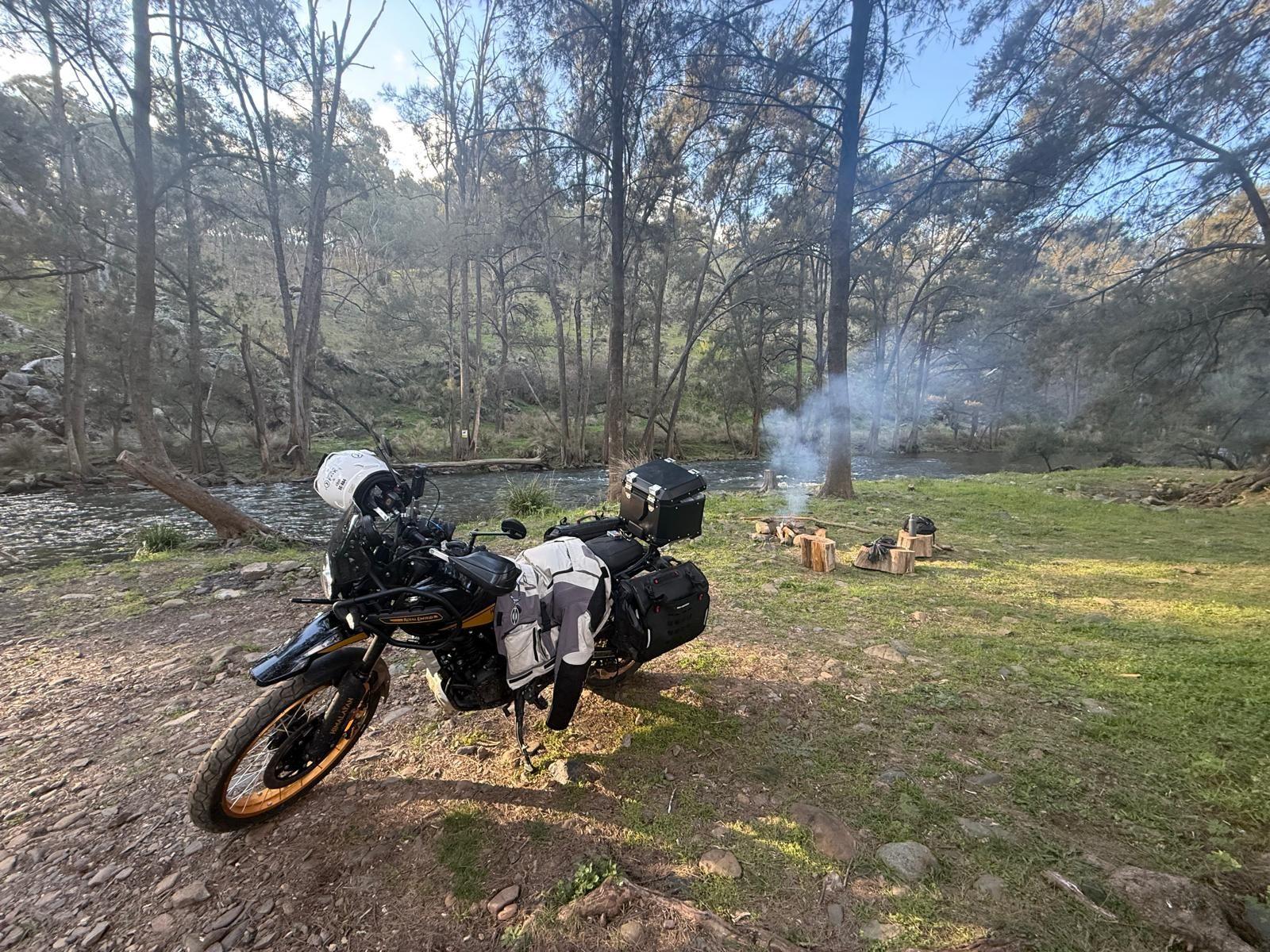
Hunter, fully loaded, three months in. The panniers, the top box, the tank bag — three thousand kilometres of "this earned its keep" and a couple of "this didn’t".
Hunter is parked on the gravel outside the shed, three months and three thousand kilometres on the clock. The engine is still warm from the run home. There are droplets of condensation along the top of the cylinder where the cool morning air has met yesterday’s heat, and the headlight grille is still wearing the grit from a gravel road I took longer than I meant to. This is the bike I’ve been writing about. This is what it looks like after a season.
I bought the Himalayan 450 for three reasons that turned out to be the right ones. It costs about eleven to twelve thousand Australian on the road, which is not nothing, but is roughly half what the other 800-class adventure bikes were asking. It has a global community of owners who fix things in driveways and post the answers, which matters when you’re heading somewhere there isn’t a dealer. And it’s mechanically simple enough that the valves, the chain, the cables and the brake fluid are jobs I can learn to do, slowly, with the bike on the centre stand.
My previous bike was a CFMoto 650 MT. It was a capable machine on tarmac and terrible on dirt — top-heavy in a way no skill can compensate for, the kind of bike that punishes a tired rider for being tired. The 450 feels half a class lighter than the spec sheet says. The spec sheet says 196 kilograms wet. The bike rides like 170. I don’t know why. I stopped trying to know why.
What works
The factory suspension is genuinely good for the money. I came in expecting to budget another thousand for shock and fork upgrades before any serious off-road work, and I’ve revised that down to zero. It’s not Ohlins. It also doesn’t need to be. The bike sits, it tracks, it absorbs the medium hits without packing down on repeats.
The riding position is the quiet hero. I can stand on the pegs all day. After eight hours on the Putty Road last month, my lower back was the part of me that hurt least, which is not a sentence I could have written about any previous bike.
The engine has an honesty to it. It is not fast. That is not a complaint. Fast bikes don’t notice things — they smear the landscape into a blur and serve it back to you as a feeling. The 450 lets the country come at you at the speed the country actually moves.
At three thousand kilometres the bike has stopped being a thing and started being a partner.
What slips
The stock CEAT tyres are nervous on wet clay. Not dangerous, not dramatic — just constantly asking a question you’d rather not be answering. There’s a section of unsealed road near home that turns the colour of milky tea after a heavy rain, and on those days the CEATs are the difference between concentration and tension. TheMitas Enduro Trail Dakars are on order.
The gear-five-to-six transition at highway speed has a notch in it. You can feel it. You have to coax the lever rather than tap it, and if you tap it cold you get a false neutral and a small shot of adrenaline. Several owners on the forums report the same thing. I’ve learned the rhythm. I still find it mildly annoying every time, fifty kilometres from home and forty from anywhere.
I’ve also had a small speed-wobble at 100 km/h that turned out to be a brake-line routing issue, since fixed with an aftermarket hose. Worth knowing if you ride a Himalayan 450 and feel something similar — the diagnosis is the post.
The seat is firm enough that two hundred and fifty kilometres is the sweet spot. Three hundred is fine. Four hundred you’re paying attention to the seat instead of the road. I’ve since fitted the OEM adventure seat; the four-hour mark went away. There are aftermarket options. I’m curious how the body adapts.
The setup at three thousand
SW Motech Sysbag panniers — 27 litres on one side, 40 on the other, genuinely waterproof through two days of steady rain on the Bells Line. Stock screen. Royal Enfield adventure top box for groceries and helmet storage. That’s the whole rig at the moment. Coming next: Mitas Dakars front and rear, a Veridian cruise control for the long sealed transits, and a Garmin Zumo XT2 to retire the phone from primary navigation.
The philosophy underneath all of this is that this is a bike to learn to fix, not a bike to outsource. The road towards a round-the-world trip means becoming the mechanic, slowly, in the shed, with the manual open and the wrong socket in my hand more than once. The 450 is patient about being learned on. That might be its best feature.
At three thousand kilometres, the bike has stopped being a thing and started being a partner. The character has emerged with use, the way a leather jacket emerges from being worn rather than from being bought. The first scratch went in at six hundred kilometres and I winced. The dent in the tank from a slow drop in mud went in at fifteen hundred and I barely noticed. The bike is earning itself.
The kettle is on. The chain needs a spray. The next ride is Tuesday.
A written companion to Royal Enfield Himalayan 450 — 3,000 km owner review on the Motorcycle Seat Wisdom YouTube channel.
Get the next one
Twice a month. The next verdict and the next journey land here first — photographs, and where I’m headed next.