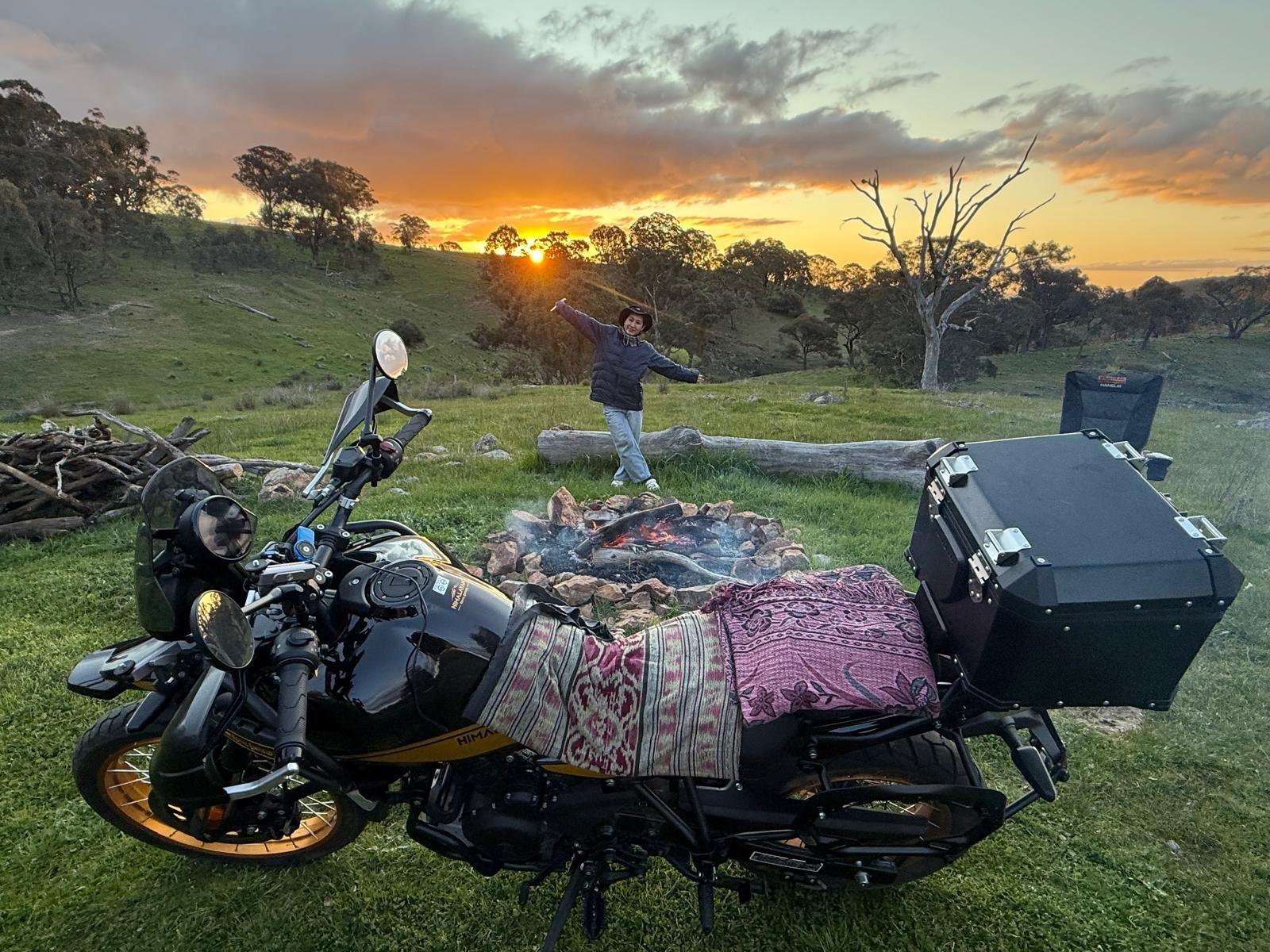
Thirty days without food, riding to Tasmania.
Sydney to Geelong, the Spirit of Tasmania across the Bass Strait, into the island — on water, black coffee, and electrolytes. The way in, before the ride proper.
The short version
I rode from Sydney to the Spirit of Tasmania on day nine of a thirty-day fast. Two days of that ride were spent in freezing rain and hail. Hunter held the road, I held the line, and the boat let us off into Devonport in a colour of light I had never seen before. What happened in Tasmania is for the long version, once the ride has had time to settle.
The Spirit of Tasmania leaves Geelong in the evening. I had not eaten for a week and a half by the time I rolled the bike up the loading ramp, and the first honest thing I can say about the crossing is that the boat felt unreasonably warm. Not hot. Not cold. Warm in the way a kitchen is warm, when there is no kitchen of your own to go home to. I parked Hunter where the deckhand pointed, locked it, climbed the stairs, and was still climbing the stairs when the boat pushed off the wharf.
The fast had been a deliberate thing — water, black coffee, electrolytes — and a long private question about what the body actually wants when you stop offering it the usual answers. I’ve written separately about the reasons, the risks, and the line; this piece is about the riding it produced. Day one, I had ridden out of Sydney with a tank full and a pannier empty of food on purpose. By day nine, the appetite had stopped arguing. The road had taken its place. There is a kind of clarity that arrives a few days into a fast that does not feel like deprivation; it feels like the volume on everything else going up.
There is a kind of clarity that arrives a few days into a fast that does not feel like deprivation. It feels like the volume on everything else going up.
The first day of any long ride is the day you find out which of the things you packed are decoration. Out of Sydney through the southern suburbs, onto the highway, and then off the highway as soon as I could manage — the highway is the road that treats every rider the same and every rider hates it for that. The country south of the city in early March still has the dry, brittle look of late summer. Paddocks the colour of old paper. Eucalypt that has had enough of the sun.
I rode without lunch because I was not eating, and the small private pleasure of that was: I did not have to stop. Petrol was a stop. Water was a stop. Nothing else had to be one. The first day ended somewhere on the Hume, on a flat patch of dirt that someone’s ute had been on before mine, and I drank electrolytes and went to sleep listening to the truckies a long way off.
Somewhere around day eleven, I let the GPS plan the route. This is not the kind of decision I usually make — the bike is the thing I ride to escape from being told — but I had been on the road long enough that the small acts of resistance had started to feel like wasted effort. So the route from Oberon to Tumut was, that day, an algorithm’s best guess. The algorithm had not consulted the weather.
Two hundred and fifty kilometres of freezing rain. Then hail, which the rain had been waiting to introduce me to. Hail in motion at sixty kilometres an hour is a thing that happens to the visor before it happens to you, and you find out very quickly whether your jacket is the jacket you said it was when you bought it. Mine held. The gloves did not, exactly. The hands stopped reporting in around hour two and were not back online until somewhere near a service station outside Tumut, where I stood next to a coffee machine I could not drink from and waited for the body to come back.
Amor fati — love what is. The road in front of you is the only road, and the weather on it is the only weather.
The Stoics had a phrase for the day I was having and I had been muttering it to myself since the first proper sting of hail. Amor fati. Love what is. It is the kind of phrase that is annoying when you are warm and useful when you are not. The road in front of you is the only road. The weather on it is the only weather. The bike, soaked, still goes. So you go.
The Spirit of Tasmania is not a romantic boat. It is a working boat, with the acoustics of a multi-storey car park and the lighting of one too. But there is a moment when the wharf falls back from the rear deck, and the wake fans out behind the hull, and the city you have just been carrying for a thousand kilometres becomes a thing you can see all at once, getting smaller. That moment is the moment the ride changes. You have stopped going. You are being moved. The body, which on a fast has been doing one quiet thing for nine days, finally has nothing to do, and uses the gap to ask you, in a voice you have not heard for a while, what exactly you think you are doing.
I slept in a chair on the upper deck because I had not paid for a cabin. The fast was on day ten, then day eleven, then day twelve when I woke. Bass Strait is not a kind crossing — it is the strait that has eaten more boats than the rest of the southern coast combined — and the boat moved through the night the way a working boat does, which is to say without making any apology for it. I read a paragraph of a book and did not read another one. The water did its thing.
We came into Devonport in the kind of light Tasmania reserves for arrivals. Pale, clean, cold. I rolled Hunter down the ramp last because I had been the last one loaded, and the customs man in the orange vest waved me through without speaking, and the road outside the terminal turned out into the country immediately, the way roads in Tasmania mostly do.
I rode for an hour before I stopped. Then I drank water, looked at a map I had not opened in two days, and started the part of the journey this post is not yet for.
A written companion to Episode 6 — Thirty Days Without Food, Riding Across Australia and Episode 7 — I Let AI Plan My Motorcycle Journey on the Motorcycle Seat Wisdom YouTube channel. The long-form version of the Tasmania ride itself will land here once the ride has had time to settle.
Get the next one
Twice a month. The next verdict and the next journey land here first — photographs, and where I’m headed next.