Brave New World, and the small protest.
Huxley’s 1932 novel, read on the bike. The soma economy, the Savage, and why a long ride alone is a small protest against the engineering of a soft life.
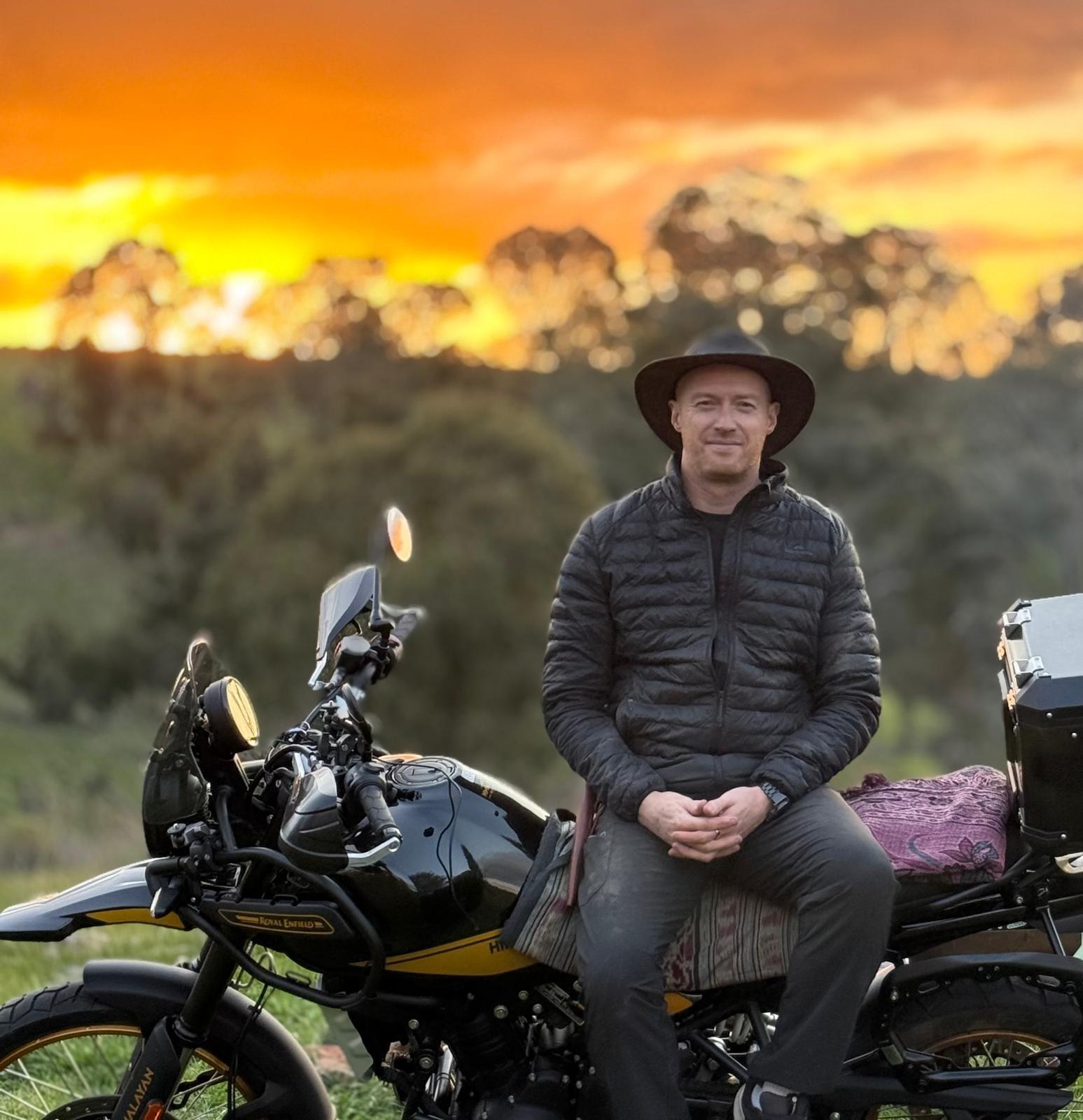
I bought a second-hand paperback of Brave New World in a dusty shop in Lithgow because the cover was three dollars and the timing was deliberate. I was about to spend Christmas Eve alone in a rainforest in Yarramalong, on the bike, and I wanted to read the book that had named the trade I was about to make. Huxley published the novel in 1932, and the strange thing about reading it ninety-four years later, in a tent, on a small motorcycle, is that almost everything he was warning about has been built and shipped and sold under three-year financing.
The set-up is famous enough to skim. A future World State has solved the problems of hunger, disease, war, work, and uncertainty by engineering them out of the human experience. Children are decanted from bottles into pre-sorted castes. Conditioning from infancy ensures that nobody wants what they cannot have. A drug called soma is available everywhere, free, and removes any flicker of negative feeling that might cause trouble. The two characters who notice that something is missing — Bernard Marx, an alpha with an unfortunate physiognomy, and the Savage, John, raised on a reservation outside the system on a copy of Shakespeare — spend the second half of the book trying to find the words for what is wrong, and failing.
Huxley is a worse novelist than Orwell. The characters do not really live, the plot is more diagram than story, and the writing has the dry, slightly clinical tone of a man who has thought himself out of being able to feel his own argument. None of that matters. Brave New World is one of the great philosophical fictions precisely because it is a diagram. The diagram is the point. Where Orwell’s 1984 imagined a tyranny that stamped a boot on a face, Huxley imagined one that smothered them with a pillow. The boot is easier to write about because the boot is dramatic. The pillow is harder to write about because most of us are already under it.
Where Orwell imagined a tyranny that stamped a boot on a face, Huxley imagined one that smothered them with a pillow.
The thing the book gets right that the dystopian shelf has never matched is the specific texture of the soma economy. Soma is not evil. It is comfortable. It is freely available. Nobody is forced to take it. The state does not need to force anything — the conditioning has done the work. The result is a population of docile, faintly anxious, perfectly adjusted people who would not recognise a real problem if one walked up to them in the lift, because the conditioning has trained them to dose themselves before the discomfort reaches conscious notice. Huxley wrote this in 1932. He did not know about phones, or about TikTok, or about the precise dopamine schedules that the recommendation algorithm has now optimised. He did not need to. He had the structure.
The Savage is the book’s only honest character, and Huxley has the courage to make him difficult. He is not a noble outsider. He is angry, sexually confused, moralistic, half-mad with Shakespeare and the cold he caught off the reservation. He objects to soma not because he has a better answer but because he can feel that the question has been smothered. By the end he is whipping himself in a lighthouse outside London, watched by tourists who have come to see the freak. The book ends on a body. Huxley does not let either side win, which is the second thing he gets right.
The slow turn, for me, was the realisation that the book is not really about a future. It is about a temptation. Every functioning society has a soma version of itself available, and every functioning person has the option of taking it. Most of us are taking it most of the time. The screen is soma. The infinite scroll is soma. The streamable, skip-able, unobjectionable middle of every cultural product is soma. The pre-mixed cocktail in a can with eight per cent alcohol and a flavour designed to bypass the tongue is soma. The point of the book is not that any of these things is uniquely sinister, it is that the cumulative effect of all of them, taken together, is a population that cannot remember why it would want anything else.
The motorcycle is one of the cheapest available antidotes. Not the only one — hiking, surfing, sailing, gardening, raising children, sitting still in a chair for an hour with no input would all do the same job. What the bike does specifically is put a body that has spent the day climate-controlled and screen-fed into a small piece of weather, with consequences. You cannot scroll on a motorcycle. You cannot be partially present. The cost of inattention is high enough that the head clears the cache and pays attention to the road, the wind, the bike, and itself. Two hours of that is a vote against the soma economy. Six hours of it, with a tent at the end, is a small protest.
I wrote the field note from that night in Yarramalong as Indoor cats, and the savage — the longer answer to what the book had asked me. The video is Episode 4: Why I chose the savage life, filmed on the deck of the same Hipcamp on the same night. The short version of the answer is that I would rather be cold and bored occasionally than warm and sedated permanently. The book did not give me that answer. The book asked the question clearly enough that the answer arrived without my having to invent it.
Read it slowly. It is short. The language is dated — Huxley was an Edwardian writing about a future, and the Edwardian shows — but the diagram underneath the language is exactly as accurate now as it was when he drew it. There is a reason the book has not gone out of print since the year my grandfather was born. The pillow is the same pillow. The Savage is still in the lighthouse. We are still choosing.
The companion field note is Indoor cats, and the savage — written from a Yarramalong rainforest with the book on the deck. See also the rest of the tank-bag library.
Get the next one
Twice a month. The next verdict and the next journey land here first — photographs, and where I’m headed next.