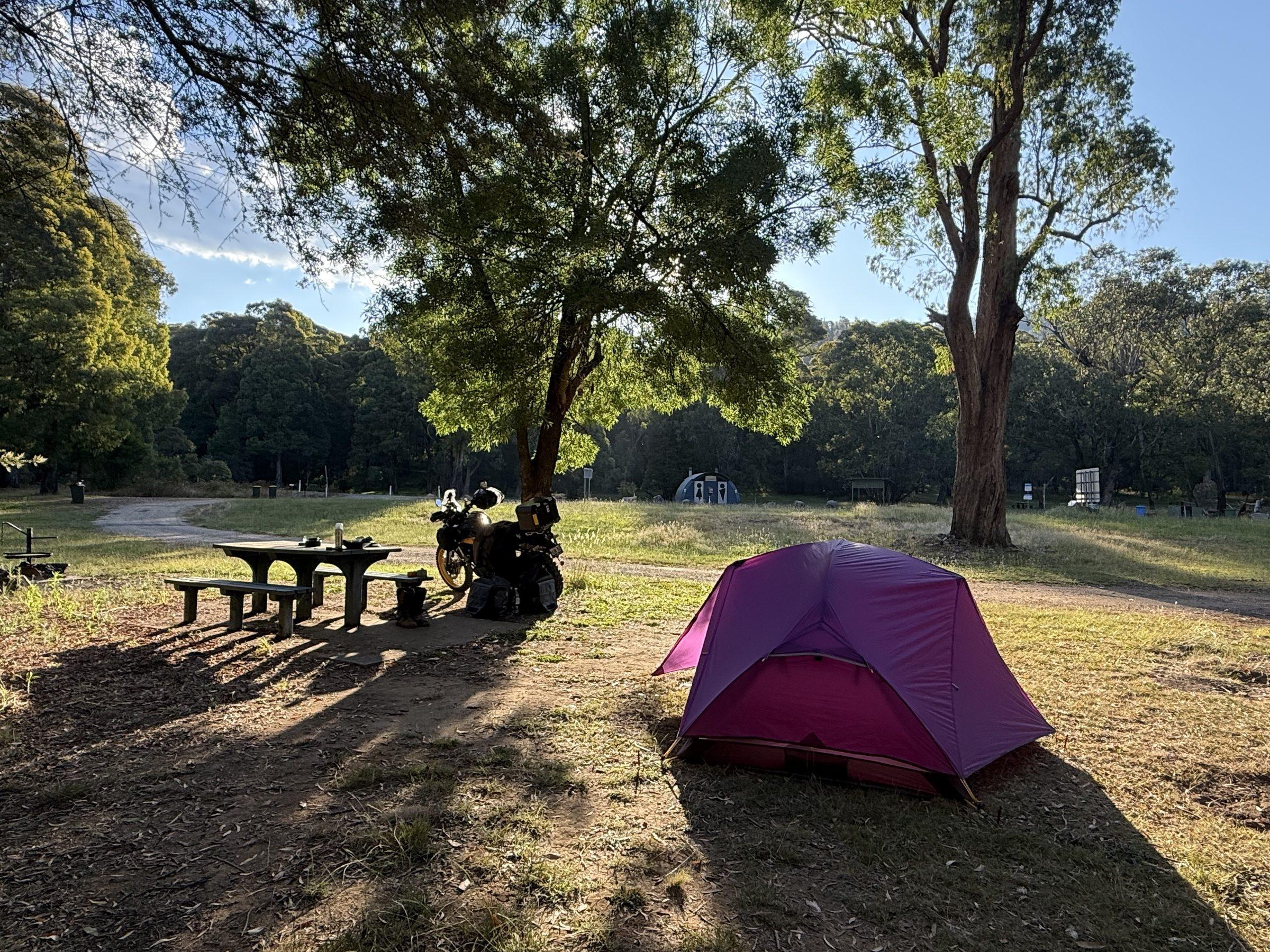
The day the brain caught up.
Day four out of Sydney. Talbingo, the thermal pools at Yarrangobilly, up over Kiandra, then crossing into Victoria to camp on Wheeler Creek. About 230 km — and the slow business of stopping being at work.
The short version
Day four of a long trip from Sydney to Tasmania to New Zealand. Two hundred and thirty kilometres through the Snowy Mountains, across the Murray, and down into the Nariel Valley to camp on Wheeler Creek. The riding is easy. The arithmetic going on inside my head is not. Somewhere between Talbingo and Kiandra the corporate brain finally lets the road have it.
The first three days out of Sydney are a kind of administration. The bike is the bike. The route is a line. You stop where the daylight tells you to stop, and you eat what your body asks for, but the version of you doing all of it is still the version that wakes up at 06:40 to a calendar. Day four is when something starts to shift. Not all at once. Not anywhere you can point to on the GPS. But by the time the road tips down off the Kiandra plains, the part of me that thinks in fortnights has gone quieter than the part of me that thinks in horizons. (For the shorter, theme-side companion to this day, see Not working, and the brain catching up.)
I roll out of Log Bridge Creek a little after eight. The tank bag is in the wrong place again — too high to stand over comfortably — and I make a mental note to move it before Mt Hotham. The Himalayan 450 starts on the second pump of the decompression lever, the way it always does in the cold. Hunter is loaded for the long haul: thirty thousand kilometres ahead of us, give or take, with Tasmania still on the wrong side of the Bass Strait and New Zealand on the wrong side of the Tasman after that.
The mountains take it all back eventually.
Tumut sits at the bottom of a long valley with the Snowy Mountains stacked behind it. The road out climbs and twists in equal measure, the kind of bitumen that rewards a slow throttle hand. Talbingo is the small lake town on the way up — hydro country, the kind of place where the road signs talk about water releases and turbines. I don’t stop. The light is already getting on, and there is colder country ahead.
Yarrangobilly is what you pull over for. The thermal pools have been in continuous use since the eighteen-hundreds — colonial bathers, then ski parties, then the quieter modern parade of travellers who park at the top and walk down through the gum scrub to the river. I don’t go down. The walk takes the better part of an hour each way, and the day has a campsite in it that I’d rather find in light. But I stand at the lookout, drink half a thermos, and watch a kookaburra try to eat something it has misjudged the size of.
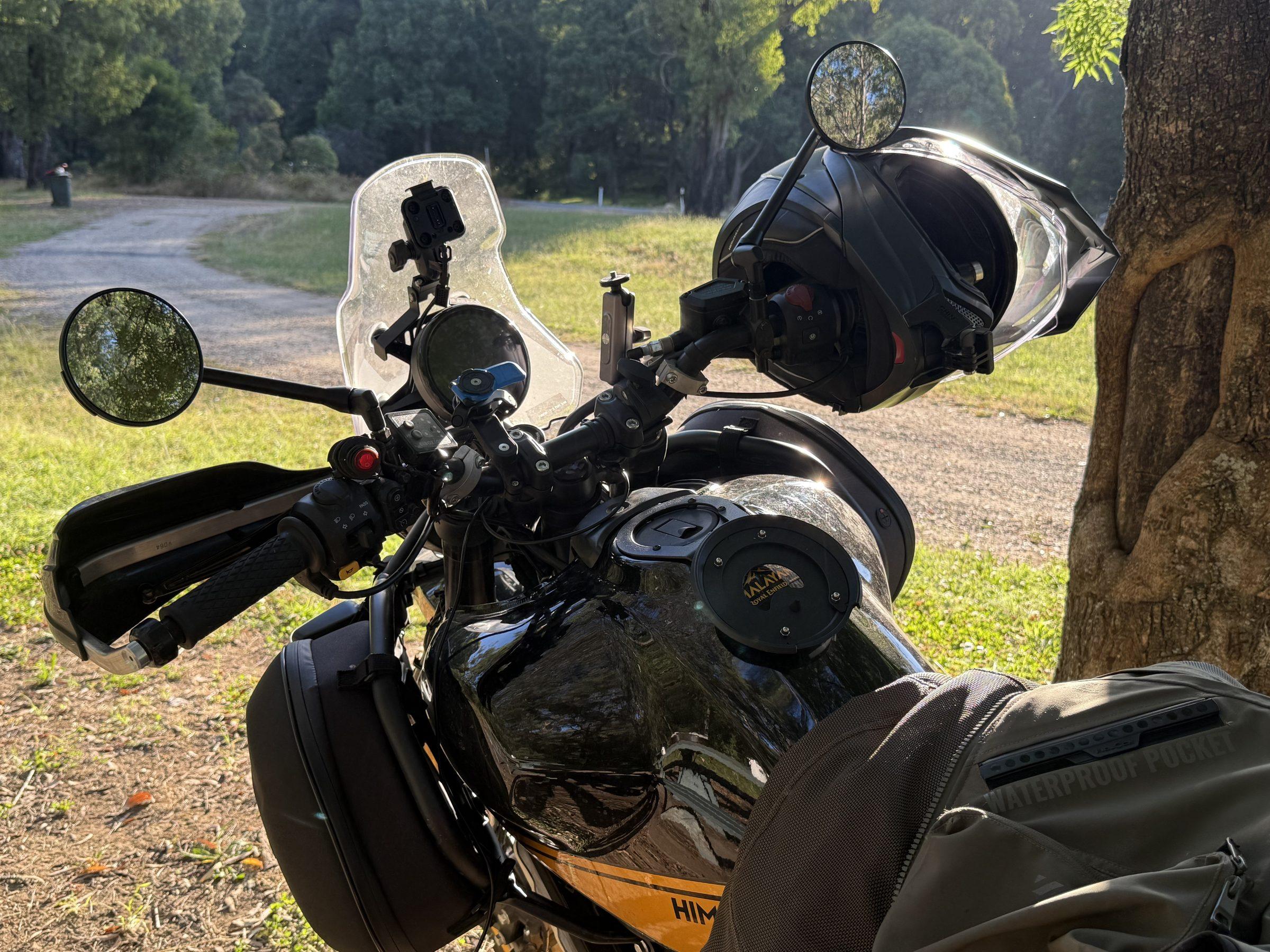
The cockpit. The tank bag is in the wrong place. By Mt Hotham it will be moved.
You’d never pick it riding through. The plains above Kiandra are open and wind-bitten and look like country no one has ever been particularly interested in. But Kiandra was once one of the biggest gold rush towns in the country — thousands of people up here in the eighteen-sixties, working alluvial seams that ran fast and didn’t last. It is also widely repeated as the place skiing in Australia began: Norwegian miners brought their skis over, set up what some call the southern hemisphere’s first ski club, and chased the same gold uphill that everyone else chased downhill.
Now there is barely a chimney left. The buildings were dismantled or moved or burnt over the years, and the country has done what country does. The mountains take it all back eventually. I ride through at the speed limit, which is too fast for a place that should be looked at, and slow it on the long descent off the plateau because the wind has picked up and the bike is pushing sideways in the gusts.
Day four out, and the brain’s finally catching up.
The crossing into Victoria is unceremonious — a small sign, a small river, a tightening in the chest you wouldn’t notice if you weren’t looking for it. Colac Colac is one of those Victorian high-country names that takes longer to say than the town takes to ride through. The road from there to the Nariel Valley winds through farming country: bullocky paddocks, cattle in long lines, a couple of working dogs that take a professional interest in the bike before deciding I am not worth the chase.
The Nariel Valley sits on Yaithmathang and Dhudhuroa Country, on a long-standing travel corridor that connected the Omeo people with the Bogong High Plains, the Upper Murray, and the Snowy Mountains beyond. White pastoralists put it under a station — Old Nariel — held by the Wheeler family, which is why Wheeler Creek is the creek you sleep beside. The valley was worked for gold from the eighteen-sixties right through to the Depression. Two surges: eighteen seventy-eight, when fifty-odd claims were active, and the nineteen-thirties when the country was desperate again. Mines called Lady Loch and Saltpetre United. Small settlements at Sunny Point, Sassafras Creek, Saltpetre Creek, Cribbage Creek, King’s Camp.
Stacey’s Bridge is the kind of free camp you don’t quite believe exists when you first ride into it. A clean stretch of grass beside a clear, quick creek. A picnic table. A toilet — wheelchair-accessible, even — that smells of nothing at all. River pools deep enough to swim in. Forty-six kilometres south of Corryong, signposted off the Corryong–Benambra Road, and on a Sunday in May there is exactly one other vehicle in the whole reserve.
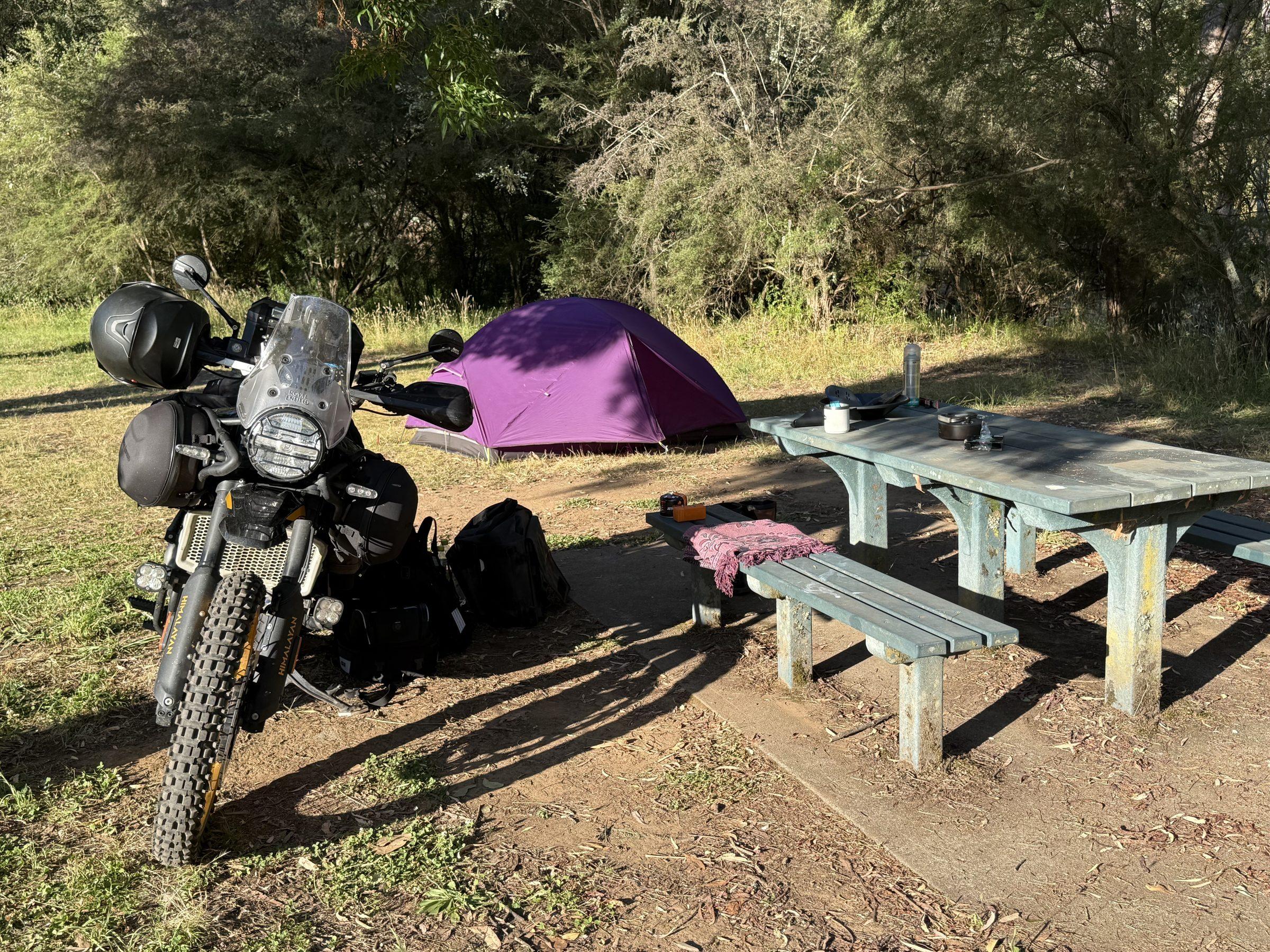
River, picnic table, even a toilet. And weather you can’t argue with.
They worked this creek for gold from the eighteen-sixties right through to the Depression. Over fifty claims at the peak. Whole valley full of people once. So obviously, I’m going to try. I set the camp first — tent up against the tree line, fire ring inherited from whoever came before, kettle on the gas stove for the first hot drink of the afternoon. Then I take the pan down to the bend where the current slows on the inside, and I start the same slow business of scooping and swirling and tipping that I have been learning since the Turon.
The first pan turns up a lot of magnetite, a couple of small garnets, and a bull ant bite on my left hand. The second pan does the same, minus the ant. By the fourth pan I have all the signs of gold in this creek — the heavy black sand gathering well, the right minerals settling in the right places — except the gold itself. The Nariel Valley diggers had a hundred and seventy years and thousands of pans on me. Whatever they didn’t take, the floods have moved somewhere I am not standing.
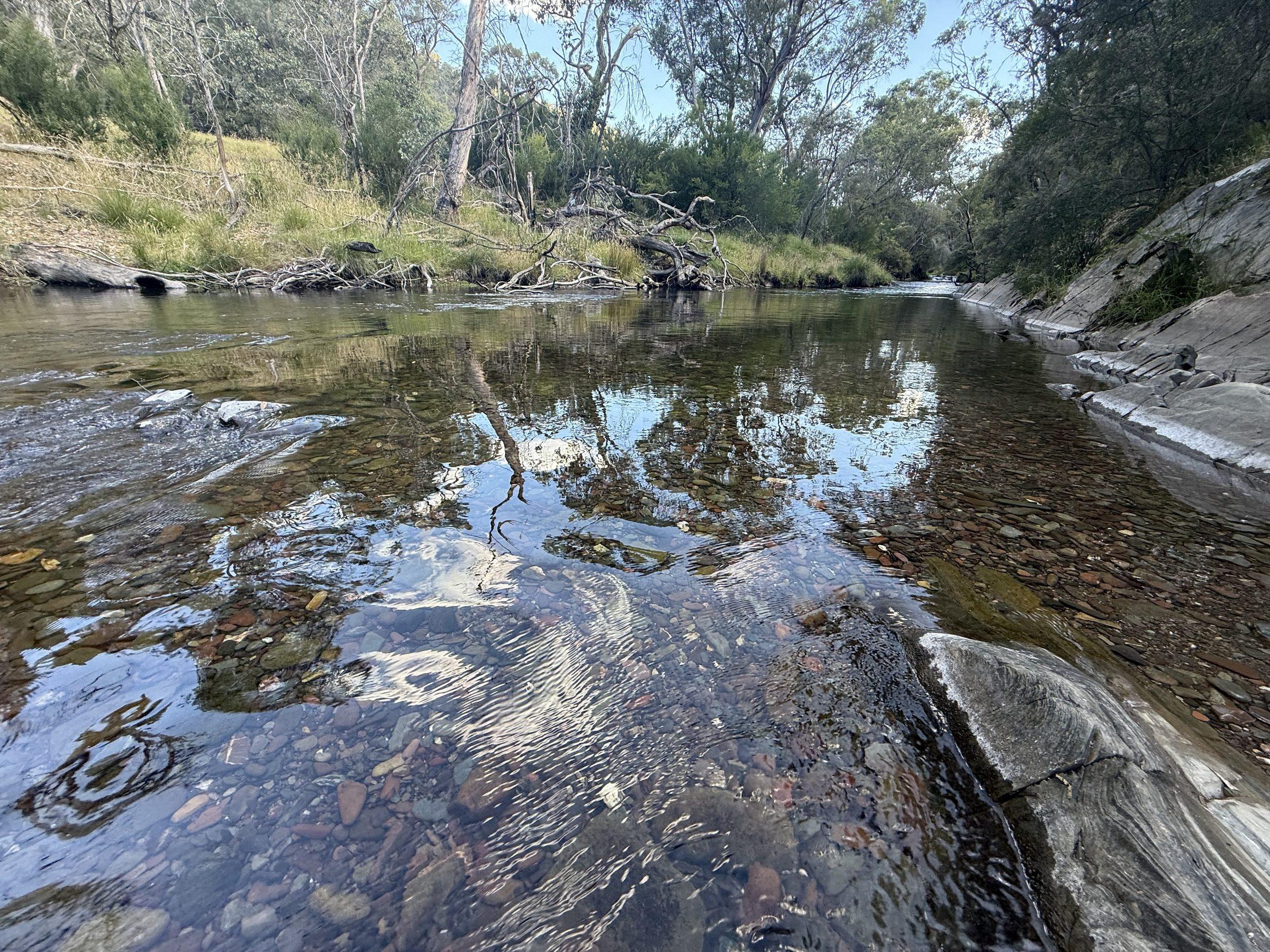
Wheeler Creek runs clear over the diggers’ old workings. Read the river for the places it gives up.
I wash my hands and arms in the creek — colder than I’ve felt water in a while — and walk back up to camp without anything in the pan except a quiet sort of satisfaction. The point was the panning, not the gold. It almost always is.
River. Picnic table. Even a toilet. Day four out, and the brain’s finally catching up.
The fire goes on the second strike of the ferro rod. The sun drops behind the western ridge a little after five. There is no signal here — a small mercy — and the only competition for the sound of the creek is the long, slow clack of the engine giving its heat back to the evening. Tomorrow it’s back to dirt: up to Mt Hotham for a night, then out through Dargo and down out of the mountains. About forty per cent of the way from Sydney to Geelong now, where I catch the ferry across to Tasmania.
The tank bag will be moved. There are a few more adjustments to come. But I feel ready. Confident, even. Quiet, even.
A written companion to Episode 8 — Tumut to Stacey’s Bridge on the Motorcycle Seat Wisdom YouTube channel.
Related reading
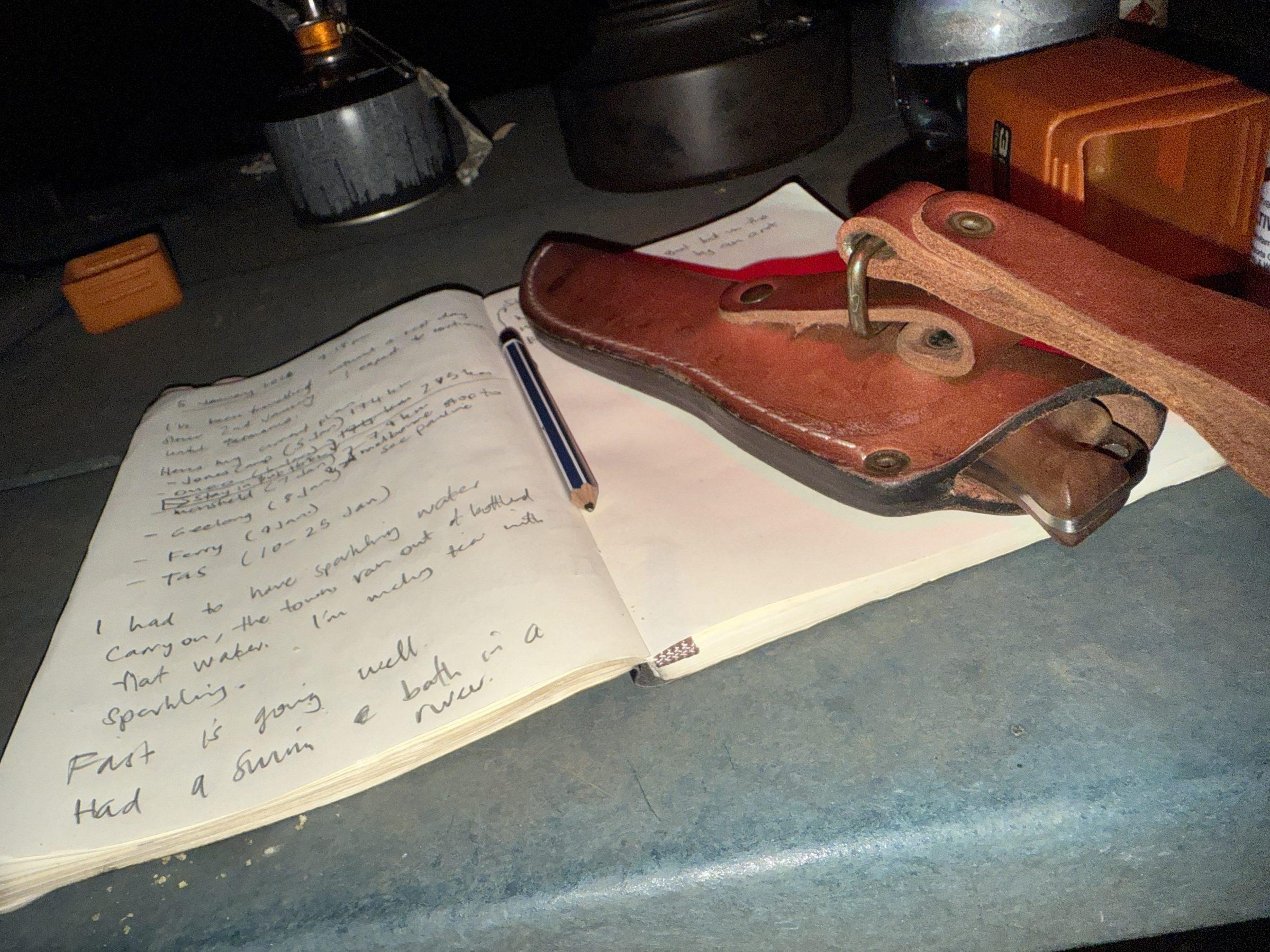
Not working, and the brain catching up.
Two meanings. I’m not working. And the brain isn’t working the corporate way — it keeps trying to. Day four is when something finally gives.
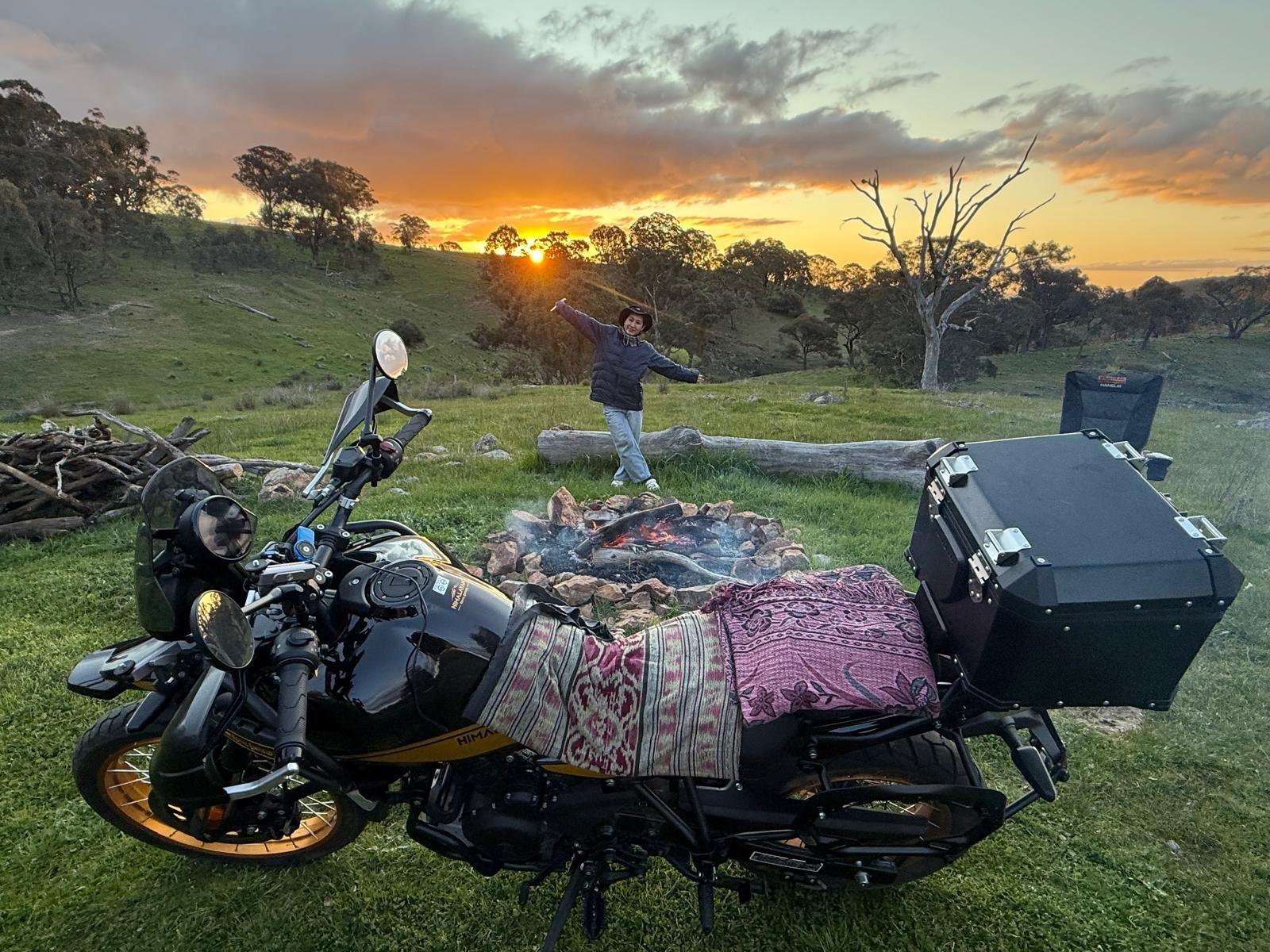
Thirty days without food, into Tasmania.
The way in, before the ride proper. Sydney to Geelong, the Spirit of Tasmania across the Bass Strait, into the island on water and electrolytes.
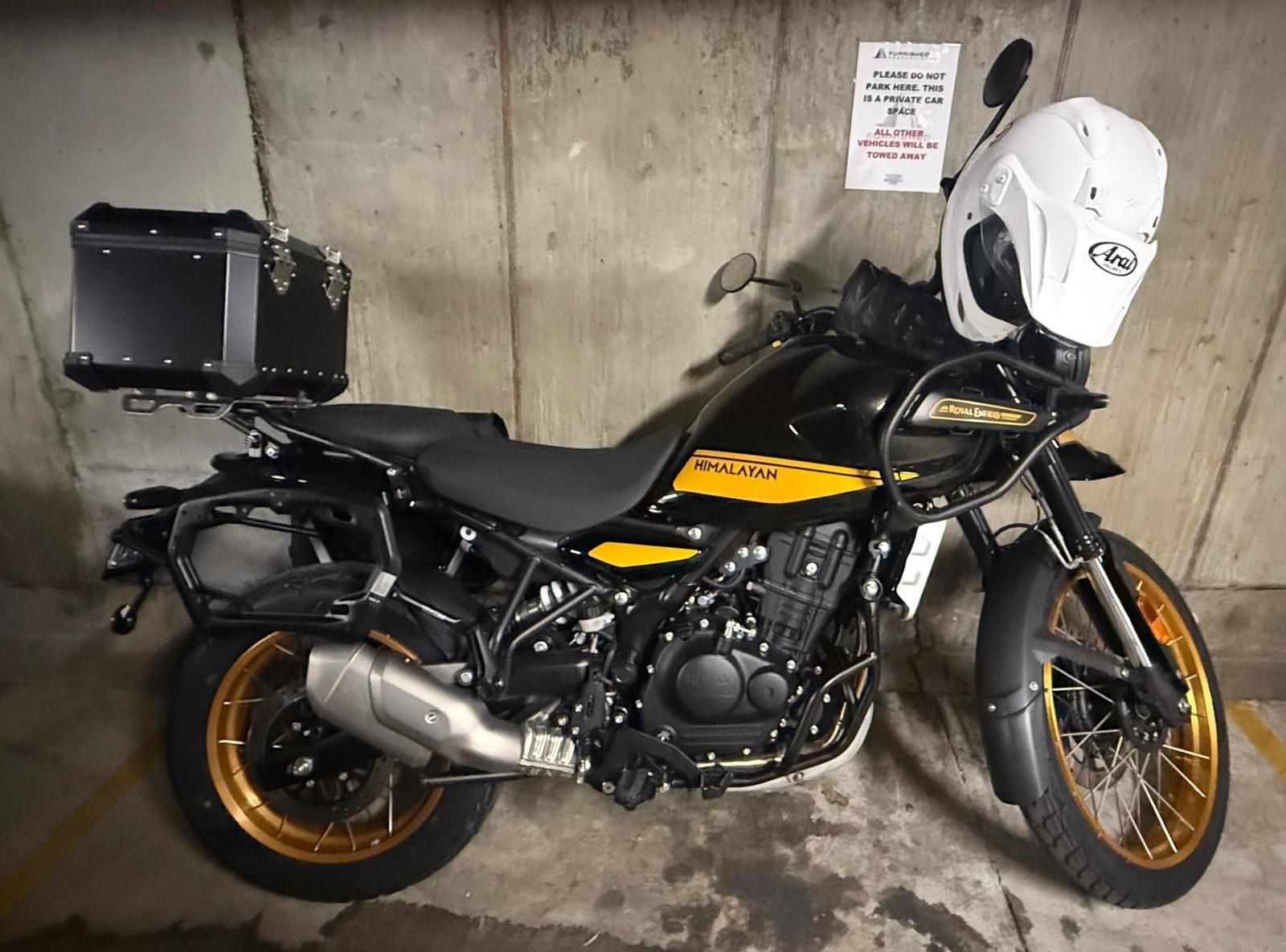
Hunter — what’s running, what’s broken.
The 2025 Royal Enfield Himalayan 450, dirt-shod for the long road. Every change, every dollar, and the small mechanical regrets.
Get the next one
Twice a month. The next verdict and the next journey land here first — photographs, and where I’m headed next.