Garmin InReach Mini 2 — the satellite messenger on a motorcycle shoulder strap.
The satellite messenger that lets a solo rider go where there is no signal. The subscription that’s actually worth it. The SOS I haven’t pressed, and what the device really does for a person who rides alone.
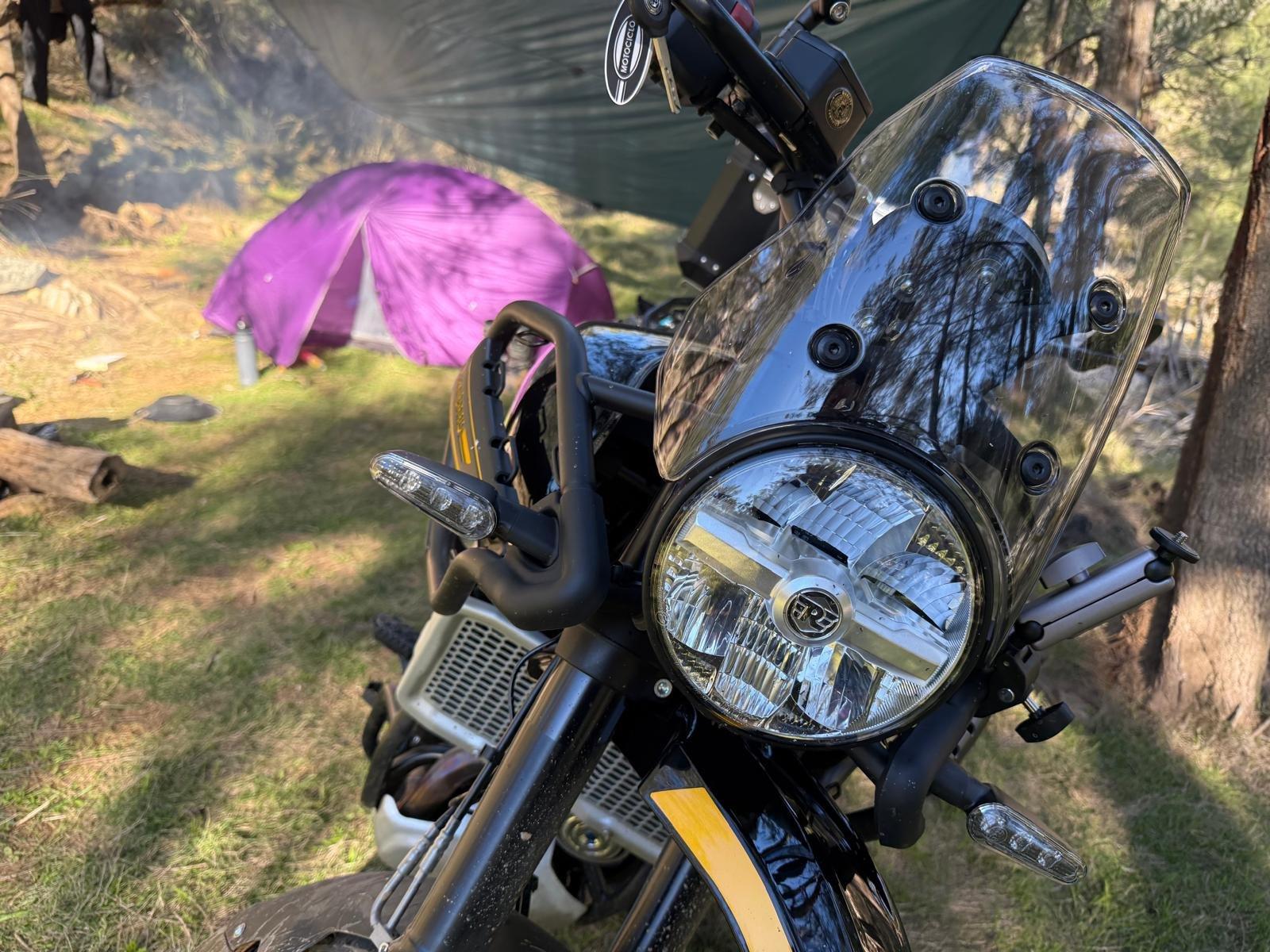
Camp on Crown land, no signal, the InReach clipped to the shoulder strap. The first send of the night is always “arrived safe.”
The InReach Mini 2 lives clipped to the left shoulder strap of my Kriega R30. It is the size of a deck of cards, weighs one hundred grams, and is, in plain terms, the most important small object on the bike. It is the reason my partner does not lie awake at 2am when I am ten hours into a ride and silent. It is the reason I will go down a Crown land road I have never seen, in a country I have just moved to, with the sun about to set, and not feel I am being reckless.
The InReach is a satellite messenger. It uses the Iridium network — eighty-six low-orbit satellites that cover the planet — to send and receive short text messages, to log GPS tracks, to send SOS signals to a global search-and-rescue centre, and to share live location with one or more chosen people. It does not need cell coverage. It does not need a phone. It needs sky.
I have run it for ten months on a 2025 Royal Enfield Himalayan 450, across roughly twelve thousand kilometres of riding in New South Wales, Tasmania, and Northland. This is the long-term review.
The short version
If you ride alone, in places with patchy or no cell coverage, the InReach Mini 2 is not a luxury. It is the one piece of kit that pays for itself the moment you don’t need it. The subscription is real money — budget it like insurance, not like a phone plan.
What it does
Two-way text messages, anywhere on Earth. The practical heart of the device. I send my partner a short note when I leave camp, when I arrive, when the plan changes, when the weather changes. Each message is 160 characters. They cost a fraction of a satellite minute. They go through.
SOS to GEOS / Garmin Response. One button under a hard cover, held for five seconds, sends a distress signal to Garmin’s response centre, which contacts local emergency services with your GPS coordinates. I have not pressed it. I keep meaning to test it under the test mode and keep forgetting. The day I do, I will write that up.
Live tracking. The device sends a position ping at intervals you set — mine is every ten minutes when riding, off when stationary. My partner can open a browser link and see where I am, in real time, on a moving map. We treat this as the boring agreement: she checks once at lunch, once before she goes to bed. If she ever doesn’t see a ping for an hour during a riding day, she rings.
Weather forecasts at point. A premium feature on the higher subscription tiers; you send the device a weather request and it returns a basic 48-hour forecast for your location. I use this maybe twice a month. On the right day — ridge weather coming in over the Tarkine, say — it has paid for the month’s subscription by itself.
GPS breadcrumb logging. The device records your track even when no satellite uplink is happening. Plug it into BaseCamp at home; the day’s ride is there as a GPX file. Useful for trip reports. More useful for search-and-rescue, in the event the worst happens.
What it earns
The subscription is the product. The device is one hundred and seventy US dollars on a hardware basis. The subscription is what makes it useful. I run the “Standard” tier at A$45 per month, which gives me unlimited text messages, ten-minute tracking, and on- demand weather. The cheaper “Safety” tier (A$23) caps text at ten per month, which is fine for hikers and not enough for an active rider. The premium “Expedition” tier (A$95) is what you take to the Pamir Highway. For Australasian riding, Standard is the answer.
Iridium is genuinely global. I have sent messages from a tent on the Bridle Track on the Turon, from a parking-lot at Devonport waiting for the ferry, from a ridge above the Pieman River in north-west Tasmania, and from a remote farm gate near Pouto. Every one of them got through. There is a small lag — thirty seconds, two minutes, occasionally five — and there are dead spots under heavy canopy. But the device gets you to where the network gets you out.
The size and the mount. One hundred grams. Clip on the strap. There is also a RAM-style bar mount for powered tracking on the bike; I tried it and went back to the strap because I trust my body more than the bike for keeping the device with me in the event of a crash.
It pairs with your phone. The Garmin Messenger app lets you compose long messages on a phone keyboard and the device sends them in chunks. It works. The phone is not required for the device to function — this is critical — but the phone makes typing pleasant.
The InReach is the one piece of kit that pays for itself the moment you don’t need it.
What it costs
The subscription, year after year. Five hundred and forty Australian dollars a year on Standard. There is an annual contract that drops it to about three-eighty if you commit, and a freeze option that suspends the service for a $10 monthly fee while you’re not using it. I keep mine active year-round because the moment I am between trips is exactly the moment I would forget to re-activate before the next.
The interface is small. Two hardware buttons and a one-and-a-quarter-inch screen. The native menu is fine for SOS and pre-set messages; for anything longer you compose on the phone. This is a feature, not a bug, on a wet day with cold fingers.
The battery. Garmin claim 14 days at 10-minute tracking; I get about ten in real-world use with active messaging. Charge it overnight at camp from a small power bank or, if powered, from the bike. USB-C. Nothing exciting.
Compared to alternatives
SPOT X. Cheaper hardware, cheaper subscription, uses the Globalstar network which has better coverage in North America and worse coverage everywhere else. If your riding is North American, the SPOT X is a reasonable alternative. If your riding is Australasian, the Iridium network on the Garmin is the right answer.
Apple iPhone 14+ satellite SOS. The new generation of iPhones can send a satellite SOS in an emergency. Useful as a last-resort backup if you forget the dedicated device. Not a substitute — the Apple feature is emergency-only, no two-way messaging, no tracking, and relies on a phone with battery and a clear sky and a functioning screen. The InReach does the same job in worse conditions, and does the four other things besides.
ZOLEO. A genuinely good alternative; uses the Iridium network too, with a more elegant phone-app interface. The hardware is slightly larger and there is no on-device screen for emergency-only use. If you are picking between Garmin and ZOLEO, you are picking between two good answers.
EPIRB / PLB (personal locator beacon). Different tool. A PLB sends a one-shot SOS with no two-way communication. Fifty bucks a year for the licence, no subscription. If your riding is occasional and your budget is tight, a PLB plus a phone is a defensible setup. You give up the everyday peace of mind that the InReach gives a partner who is at home.
Why this matters more on a motorcycle
The thing nobody quite says about adventure motorcycling is that the most likely failure mode is a slow injury in a remote place — a low-side on gravel, a broken collarbone, a bike on top of you for forty minutes while you wait for someone to come past. A car can keep you warm. A bike has dropped you, and you are now lying on the surface that dropped you, and you cannot move it on your own. This is what the InReach is for.
I dropped Hunter on a Coromandel gravel track in March, on a slow corner, with the road dipping to a stream. I was unhurt. The bike was fine after I picked it up. I had told my partner I was going down that road. She had a ping every ten minutes that said I was still upright. If the drop had been worse, the InReach was a five-second hold from a response centre. The insurance was real even when I did not need to claim it.
What I’d say to a solo rider
If you ride alone, get the InReach. If you cannot afford the InReach, get a PLB and a written plan with someone you trust. Either tool is better than nothing. The Mini 2 is the right size for a motorcycle pack, the right interface for a person wearing gloves, and the right network for a planet where the corners that get you in trouble are the corners with no cell signal.
Pair it with a partner-or-friend who actually checks the tracking page. The device is half the system. The other half is a person who has agreed to ring if the dot stops moving for an hour. Have that conversation before the ride, not during it.
Where to buy it
Garmin’s direct shop carries the Mini 2 worldwide, with pricing in your local currency and the subscription activation built into the registration flow. In Australia and New Zealand, MotoMail and similar specialist shops also stock it. The hardware is the same everywhere; the subscription is what differs by region. There is no affiliate relationship between this site and Garmin.
What’s next
The next test is the South Island. I am planning a two-week solo run along the West Coast, late winter 2026, where Iridium coverage is the only practical messaging option for half the route. I will write that up when I get back. In the meantime: if you are still riding alone with a phone in a pocket and a vague hope, this is the lever you have been looking at and putting off. Pull it. The riding gets bigger immediately.
Get the next one
Twice a month. The next verdict and the next journey land here first — photographs, and where I’m headed next.