Garmin Zumo XT2 — six months, ten thousand kilometres.
The motorcycle GPS that took routing off my phone. Glove operation, sun glare, the AI-planned route that nearly broke me, and what nine hundred and ninety-nine Australian dollars actually buys.
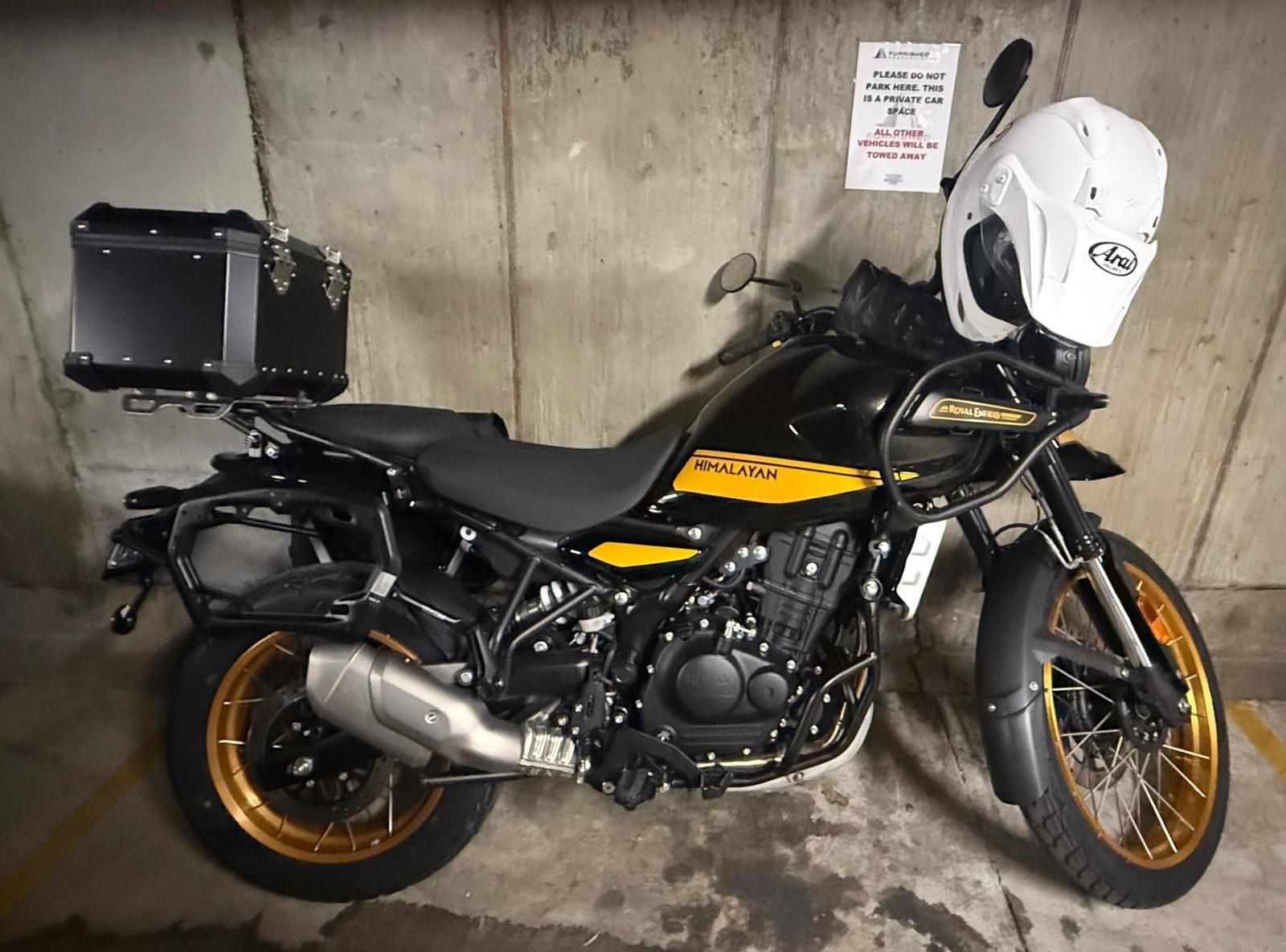
Hunter, fully loaded, in a car park before a long day. The Zumo XT2 is the small black slab on the bars, the one screen I’d trust in the rain.
The first time I used the Zumo XT2 in anger was on a wet Wednesday in October, riding from Sydney to Bilpin in light rain that became heavy rain by the Bells Line of Road. My phone, in its Quad Lock, was greasy with water and would not accept my gloves. The phone’s screen had decided I was tapping when I was not. Pulling up at a petrol station, I wiped the screen, dried my fingers, and re-routed once. By the time I had finished doing all of that the rain had eased and I had lost twenty minutes.
The Zumo XT2, mounted ten centimetres to the left of the phone, was already showing the right route. It had not noticed the rain. That was when I understood what nine hundred dollars buys. It does not buy better routing — the Zumo’s road logic is in many ways inferior to Google Maps. It buys the right screen for the conditions a motorcyclist actually rides in. Wet, gloved, sunlit, and moving.
I have now ridden roughly ten thousand kilometres with the Zumo XT2 mounted to the bars of a 2025 Royal Enfield Himalayan 450. That includes the Putty Road, the gravel between Bathurst and Hill End, the Spirit of Tasmania, the back roads of the Tarkine, and the Northland coast from Pahi out to Dargaville and back. This is the long-term review.
The short version
Buy it if you ride more than two days a month, you ride in wet weather sometimes, and you are tired of the friction of a phone in a Quad Lock. Don’t buy it if your riding is short, urban, and dry — a phone is plenty for that, and the Zumo’s routing logic will frustrate you in town.
What it earns
Glove-operable, every condition. This is the hill the Zumo dies on, and it dies on it well. The capacitive screen is tuned for thick gloves; the bezel buttons handle zoom and home with one finger. Cold morning, wet afternoon, polar fleece liner under a winter glove — the Zumo accepts every tap. The phone in the Quad Lock, in any of those conditions, accepts about half.
Sun-readable in the worst light. The transflective display gets brighter the more sun you put on it — the opposite of every phone screen ever made. The hardest light for a motorcyclist is morning sun directly behind you on a wet seal road; on the phone, that’s the moment the screen becomes a mirror. On the Zumo it stays readable.
Rugged in the actual sense. The Zumo XT2 has been rained on in Tasmania, washed by the spray off Razorback Ridge, hit by gravel kicked up from the bike in front, and run, briefly, in twenty-eight-degree direct sun in central western NSW with the bike idling at a fuel pump. It has not flinched at any of it. The case is rated IPX7 and feels it. I would not say the same of any phone I have ever owned.
The mount. The Garmin RAM-style handlebar mount on the Zumo is, on its own, worth a lot of the price. The clamp seats positively, the lock is twist-and-click rather than fiddly, and the unit comes off in three seconds for an overnight or a fuel stop. The vibration damping is good enough that the screen never flickers, even on the rough gravel where my phone in the Quad Lock had to be turned off to stop the camera autofocus from being shaken to death.
Trip planning, on a desktop. The Garmin BaseCamp software is a relic from 2014, but it works. I plan trips the night before on a laptop — vias, fuel stops, camp sites — and load the route to the device by USB-C. On the bike, the next instruction is always the next instruction; I never reach for the phone to see where I am.
The Zumo doesn’t buy better routing. It buys the right screen for the conditions a motorcyclist actually rides in.
What it costs
Routing logic that thinks like a truck driver. Garmin came up through trucking and powersports, and it shows. The Zumo’s default routing is wide-arc, fuel-station-aware, and conservative. It will route you ten kilometres further along a sealed road to avoid two kilometres of unsealed shortcut, even when you tell it you are on an adventure motorcycle. The “adventure” preference helps but does not solve it. Google Maps, on the same trip, picks twenty per cent better lines, twenty per cent of the time. The other eighty per cent the Zumo is fine, and the twenty-per-cent-better lines on Google routinely include roads that don’t exist anymore.
The price. Nine hundred and ninety-nine Australian dollars, plus sixty-four for the handlebar mount. It is the second-most-expensive thing I have bolted to Hunter. If your riding cannot support that, do not buy it. The phone-in-Quad-Lock setup works. It works worse, in the conditions where you most want it to work, but it works.
The interface is a Garmin interface. Three menu levels deep, the Zumo can be obtuse. The traffic-overlay colours have been reused since 2015. The fonts are too small in the trip-summary screen. None of this matters once you’ve learned where things are. All of it matters in the first three weeks.
The AI-planned route
In late February I let an LLM plan the route from Oberon to Tumut, a ride I now describe in shorthand as “the AI ride.” It went badly. Two hundred and fifty kilometres of freezing rain and hail on roads the AI had picked for the “views” without any sense that the views might come with weather. The Zumo kept the route. It did not panic. It did not try to reroute me to seal when the seal ran out. It turned by turn, in the cold, with the screen still showing the right thing through the fog on the visor.
Two days later, when I checked the Zumo’s ride summary, it had recorded every minute — speed, average, fuel stops, ambient temperature on the most exposed leg. Eighteen-degree drop in three hours. The data is something I would have lost on the phone, because the phone’s battery would have been long gone.
Compared to alternatives
Phone in a Quad Lock. Half the price after the accessories. Better routing in town. Worse in the rain, worse in direct sun, worse with thick gloves, worse for vibration on rough gravel. If you are riding less than five thousand kilometres a year and you mostly ride on dry tarmac, the phone is fine. The day you regret the phone is the day a Zumo would have been working.
Garmin Zumo XT (the previous generation). Smaller screen, slower processor, no LTE. Still on sale at a discount. If you can find one for half the XT2 price — and you can — it is a great buy. The XT2 is meaningfully faster on map redraws and the screen is a generation better, but the XT will get you ninety per cent of the way there.
Beeline Moto / Beeline Velo 2. Brilliant little devices for urban turn-by-turn. Useless for any kind of backcountry route planning. The Beeline pairs to your phone; if your phone is the bottleneck, the Beeline doesn’t help.
TomTom Rider 550 / 550 Premium. The European default, and on European bikes a strong choice. In Australia and New Zealand the map updates lag and the support is harder to find. I would not buy a Rider 550 for an Australasian ride.
What I’d say to a Himalayan 450 owner
The Himalayan 450 invites a kind of ride the Zumo is built for — multi-day, mixed-surface, weather-uncertain, away from cell coverage. If you have already bought the bike, you are roughly the rider Garmin built the Zumo for. The decision is whether you ride enough multi-day to cash in what the device offers. If your bike spends six weekends a year doing the Old Pacific Highway and the rest of the time parked, save the money for tyres. If your bike is your way of leaving the country, eventually, then the Zumo XT2 is the second-best dollar-for-dollar piece of kit on the bike. The first is the tyres. The third, easily, is the satellite messenger I keep next to it.
What I would change
I want a tighter integration between the Zumo and the InReach Mini 2, both Garmin devices, both on the bike. As of mid-2026 the bridge between them is patchy — location sharing works, basic two-way messaging from the Zumo to the InReach works, but routing-with-tracking is still a phone-app affair. Garmin own both ends of this chain; they ought to close it.
I would also pay another hundred dollars for a software option to disable Garmin’s “adventurous routing” entirely and use OpenStreetMap-class logic for the road grade. It is fixable in software. Two years into the XT2, it has not been fixed.
Where to buy it
In Australia, Garmin’s direct shop and the larger motorcycle accessory chains carry it at the same price. Watch for trade-show specials; Sydney Moto Expo had it at ten per cent off in late 2025. In New Zealand, Penny Homes had stock when I checked in March. In the UK and Europe, SP Connect and Garmin direct are the go-to. North America: widely available, often on a small discount.
I bought mine at full retail. No affiliate code, no sponsorship.
What’s next
The next leg of the ride is the Northland and East Cape coasts, both of which have stretches of unsealed road between fuel stops where the Zumo’s offline maps are the difference between confidence and stopping at every intersection. I will write the second-year update when I am twenty thousand kilometres in — probably mid-2027.
In the meantime: if you are still routing on a phone in a Quad Lock and your weekend mostly ends with a sore thumb from poking at a screen that does not want to be poked, the Zumo XT2 is the answer to a question you keep asking yourself anyway. Buy it once. Forget about it. Ride.
Get the next one
Twice a month. The next verdict and the next journey land here first — photographs, and where I’m headed next.