Shipping a motorcycle from Australia to New Zealand on a CPD carnet.
How I moved Hunter from Sydney to Auckland in February 2026. The cost, the paperwork, the freight forwarder, the carnet, and the slow leaving that became a slow arriving.
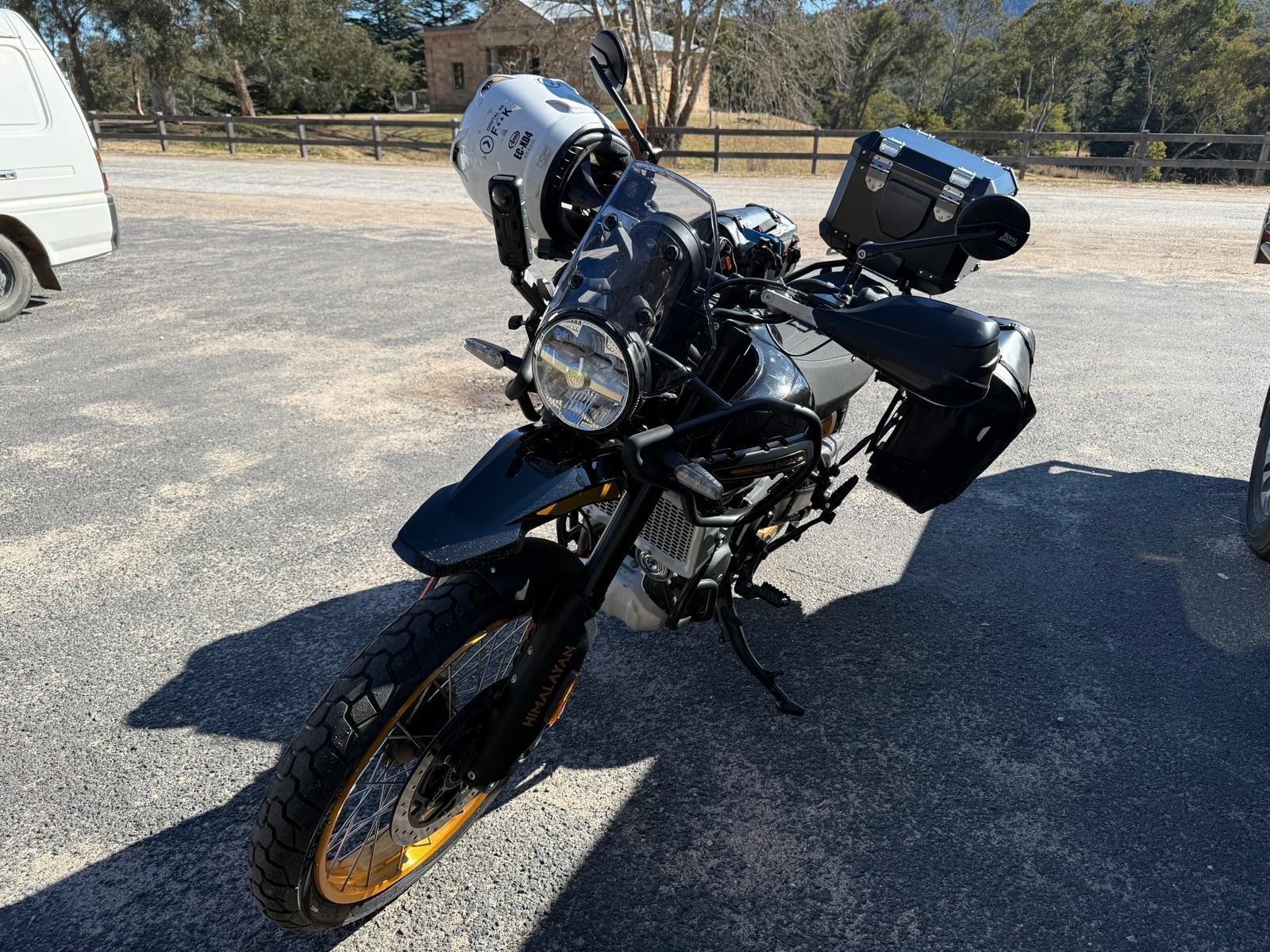
Hunter at the freight depot in Banksmeadow, Sydney, the day before the crate went on the boat. Six weeks of paperwork behind him; three weeks of saltwater ahead.
The crate was painted blue. It sat on a pallet at the back of the warehouse in Banksmeadow, Sydney, the morning before the boat. Hunter was inside the crate. The crate had a window cut in the side, big enough that I could see the bash plate and the front wheel. The freight forwarder, a man named Daniel who had moved several thousand motorcycles in his career, told me to drain the tank to about a quarter, disconnect the battery, and wedge the front and rear with two-by-fours so the bike could not shift in the swell. I did all three. I closed the lid. I walked out into the carpark and stood there for a minute before I drove home.
The next time I would see the bike was three weeks later in Auckland, on a different continent, in a country I had been to twice in my life and was about to live in. The carnet de passages en douane — the CPD carnet — was what made all of that legal, possible, and insurable. It is the document that makes a motorcycle a guest of a country rather than a problem.
I will write this guide as plainly as I can. There is almost nothing useful online about shipping a small motorcycle from Australia to New Zealand on a carnet, and there is even less written by people who have actually done it. What follows is what I actually did, what it actually cost, and what I would change if I were doing it again.
The short version
A 2025 Royal Enfield Himalayan 450, crated, from Sydney to Auckland, on a twelve-month CPD carnet, cost roughly A$3,800 all in: A$2,150 for sea freight and crating, A$880 for the carnet (RAC Australia, in my case), A$320 for biosecurity inspection, and the rest in insurance, paperwork, and the small fees that always appear at the edges. The whole process took roughly six weeks from booking to picking the bike up from the depot in Auckland. The bike itself was on the boat for sixteen days, but the paperwork either side adds the rest.
What is a CPD carnet?
The CPD carnet is an international customs document that lets you take a motor vehicle into a foreign country temporarily without paying the import duties and GST that would normally apply. The carnet is essentially a guarantee: the issuing automobile club holds a bond on your behalf, promising the destination country that if the vehicle is not re-exported within the term, the duties will be paid. In return, the destination treats the vehicle as a temporary import. No GST, no rego, no compliance — it remains an Australian-registered vehicle, riding under your Australian plate, on its Australian rego, with Australian compulsory third party.
You insure the bike separately for damage and theft — I use World Nomads for the international leg and a standard New Zealand insurance policy for the in-country riding — but the carnet is what keeps the bike from being stuck at the border with a customs bill.
The carnet is valid for up to twelve months. New Zealand honours the CPD; so do most of the countries you would ride a motorcycle through. The Carnet de Passages en Douane is recognised under the 1954 UN Customs Convention; AAA-affiliated automobile clubs (the RAC, the NRMA, AANZ) issue them. In Australia in 2026, the RAC and the AAA-equivalent issue carnets through a small handful of state organisations; the lead time is roughly two to three weeks.
Step one — the freight forwarder
I used Dazmac Logistics in Sydney. They were not the cheapest. They were, by some distance, the most clear, the most willing to answer questions in plain English, and the most experienced with motorcycles specifically. The alternatives I considered were Wridgways, JVD International, and one or two of the larger door-to-door movers. My advice, in order:
Use a freight forwarder, not a door-to-door mover.The big movers will quote you, take a 50% deposit, and then sub-contract the actual freight to someone like Dazmac. You may as well go direct.
Get three quotes. The variation is huge — from A$1,800 to A$4,200 for the same Sydney-to-Auckland motorcycle freight. The variation is mostly in what the quote includes (crating, biosecurity prep, port handling, destination clearance, freight insurance) and how the forwarder handles the carnet at both ends.
Use a forwarder that has done this before. Specifically — ask if they have crated a motorcycle with a fuel tank for sea freight to NZ in the last twelve months. Most movers will say yes. Some will say it hesitantly. The ones who hesitate are the ones who will forget to drain a fuel tank to the right level for IATA / IMO regulations and your bike will sit at the dock for an extra week.
Ask for the IMO Class 3 dangerous-goods declaration.Motorcycles ship as “dangerous goods” because of the fuel and the battery. The declaration is a standard form. The forwarder fills it out. You sign it. No declaration, no boat.
Step two — the carnet
I applied through the RAC Australia, online, in early January 2026. The application required:
The bike’s VIN, engine number, plate, valuation, and colour. A photograph of the right side of the bike, with the plate and VIN visible. A bond payment of A$880 (refundable on the bike returning to Australia, or being re-exported from a covered country, within twelve months). A photocopy of my passport. Proof of New Zealand entry within the next ninety days — in my case, a flight booking.
The carnet itself is a small booklet, about the size of a passport, with carbon-paper duplicate pages. Each border crossing tears off two leaves — one for the destination country’s customs, one for the departure country. The booklet has space for about twenty crossings. For a NZ-only twelve-month stint, I will use four leaves: out of Australia, into NZ, out of NZ, back into Australia.
Lead time was eighteen days from application to the booklet arriving. Cost: A$880 bond plus A$200 admin fee. The bond is refundable on completion. The admin fee is not.
Step three — biosecurity
New Zealand is, sensibly and famously, paranoid about biosecurity. Anything organic on the bike — mud, grass seeds, insect carcasses, dirt in the chain, anything — will be flagged on arrival and either treated at the dock (at your cost) or returned to Australia (at your cost).
The freight forwarder organised a pre-shipment cleaning at a local detailer for A$220. The detailer steam-cleaned the bike, ran a brush through the chain links, scrubbed the wheels and tyres back to clean rubber, and provided a certificate of cleanliness that travelled with the bike. On arrival in Auckland, MPI (the Ministry for Primary Industries) inspected the bike at the dock. They found a small amount of grass-seed lint on the rear wheel and charged me A$95 for an additional clean. That was the only biosecurity surprise of the trip.
Wash the bike yourself, before the detailer does. I did. It saved an extra cost on the detailer side and meant the bike arrived in Auckland clean enough that the MPI inspector found one thing instead of three.
Step four — the boat
Sea freight, Sydney to Auckland, in February 2026, took sixteen days. The boat was the ANL Wahine, a regular service between Sydney’s Port Botany and Auckland’s Ports of Auckland. Two other ships run the route weekly. Departures are Wednesday and Friday afternoons; arrivals are Tuesday-to-Friday in Auckland depending on weather and traffic. There is no reliable way to ship motorcycles by air on this corridor at any kind of reasonable cost; sea is the answer.
I tracked the boat in real time on MarineTraffic. It is an oddly comforting thing to watch a small icon move up the east coast of Australia, around the top of New Zealand, and into Auckland Harbour while you sit at home with a cup of coffee. Hunter, on a boat, in the Tasman. The slow leaving had become a slow arriving.
Step five — clearing the bike in Auckland
The bike landed at the Ports of Auckland on a Thursday morning. The freight forwarder’s NZ partner (Dazmac has a sister office in Auckland) cleared the carnet with NZ Customs at 11am the same day. I drove to the depot at East Tāmaki at 3pm, presented the carnet stub, the bill of lading, and my passport. They wheeled the bike out. I reconnected the battery. The bike started on the second go — cold, after three weeks of not running, the carb on a fast idle for the first ninety seconds.
I rode out of the depot at 4pm. I rode through Auckland traffic to a friend’s place in Mount Eden. The speedo was in kilometres because Hunter was Australian, but the road signs were in kilometres because New Zealand was. Everything that could line up, lined up.
The carnet is what makes a motorcycle a guest of a country rather than a problem.
What it cost, line by line
Dazmac sea freight, Sydney to Auckland (door to dock): A$1,650, including IMO Class 3 declaration, port handling both ends, and freight insurance to A$15,000 declared value.
Crating: A$500. A blue plywood crate with a window cut for inspection. The bike is strapped to the crate floor by the front wheel and the rear sub-frame.
RAC carnet: A$200 admin fee. A$880 refundable bond.
Biosecurity prep (Australian-side): A$220 detailer.
NZ MPI biosecurity recharge: A$95 (additional clean for the grass seed).
NZ port clearance & depot fees: NZ$140 (handling, plus a small storage fee for the time between landing and pickup).
Total, exclusive of the refundable bond:roughly A$2,800. With the carnet bond held by the RAC for twelve months, total cash outlay was A$3,680.
What I would change
Book six weeks out, not three. I booked the freight three weeks before my preferred sailing. I got the boat I wanted, but only just — the next available was eleven days later. Six weeks would have given me my pick of departures.
Wash the bike myself, then have the detailer wash it again. Belt-and-braces approach. The forty dollars I saved on the home wash was the ninety-five dollars I lost at the dock.
Get the NZ insurance policy in place before the bike lands. I had a verbal agreement with State Insurance that they would cover the bike from the moment of NZ pickup; the formal policy was issued the morning of pickup. That is too close. If the depot had been delayed by even a day, I would have been riding uninsured for that day. Schedule it to start two days before the expected pickup date.
Take photos of the bike in the crate, before the lid goes on. I did, but not enough. If anything gets damaged in transit, the freight insurance is much easier to claim if you have time-stamped photos of the undamaged bike at the moment of crating.
Ask the freight forwarder to send the carnet to the port, not to you. The first leaf of the carnet has to be presented to Australian Border Force at the port before the boat sails. I had the carnet booklet in my hand, in Sydney; the freight forwarder had to courier it to the port at the last moment. If the freight forwarder had held it from the start, that would have been simpler.
What the carnet doesn’t cover
The carnet is not insurance. It is not registration. It is not a road-worthy certificate. You still need:
Local insurance for damage and theft, in the destination country. (Compulsory Third Party rides on the AU rego.) A valid international driving permit, or a current Australian licence (NZ accepts Australian licences for the term of a temporary import). A copy of the bike’s registration papers. The carnet booklet itself, kept somewhere accessible — I keep mine in a waterproof pouch in the top box.
You also need a plan for the carnet’s expiry. In my case, the carnet expires in late January 2027. Before that date, the bike must either be re-exported (back to Australia, or onwards to a country covered by the same carnet) or formally imported into New Zealand — which triggers GST and compliance. The decision on which to do has not been made yet, and is its own essay for a different week.
Other corridors
Some readers will be looking at this guide thinking about other corridors. A short note, since the search terms cluster:
Australia → UK / Europe. The corridor is well served by Get Routed (Dave Milligan’s outfit, based in Melbourne) for an annual run. About A$5,500 each way, container-shared with other Australian motorcycles. A carnet is essential. Lead time: book a year in advance.
Australia → US. Cheaper than UK; about A$3,200 for sea freight. US Customs accepts a carnet but the US doesn’t issue carnets, so you need to source one from elsewhere — the RAC Australia carnet covers a US trip outbound from Australia.
NZ → Australia. Cheaper than Australia → NZ in both freight and biosecurity (Australia’s own biosecurity is also strict, but NZ-prepped bikes generally clean up). Same forwarders, same carnet model, about A$2,400 all in.
Why bother?
The riding is why. New Zealand has the road network of a country that has been engineering for terrain since 1840 — the East Cape, the Coromandel, the Catlins, the West Coast, the Forgotten World Highway. None of these are roads you can ride on an Australian licence and an Australian bike unless you have moved the bike. The carnet is what makes that movement legal. The freight forwarder is what makes it possible. Three thousand eight hundred dollars is what makes it real.
Hunter has been in New Zealand for ten weeks at the time of writing. He has been in the rain twice and the sun three times. He has crossed the harbour in a small cattle ferry and survived it. He has been ridden out the back of Pahi on roads that don’t appear on any map I have downloaded. The carnet is in the top box. The slow leaving has become a slow arriving has become the riding I came here to do.
Useful contacts
Dazmac Logistics (Sydney): freight forwarder. Daniel there knows motorcycles.
RAC Australia: carnets. The carnet@rac.com.au email is answered within a day, in plain English.
MPI (NZ Ministry for Primary Industries): biosecurity. The motorcycle import-clean checklist on the MPI site is the most useful single document for prep.
Get Routed (Melbourne): annual UK / Europe corridor for Australian motorcycles. Worth a phone call even if you are doing NZ — Dave knows everyone in the freight chain and will tell you who to talk to.
What’s next
I will write the second half of this story when the carnet expires — the decision to re-export, or to import the bike to New Zealand permanently, is the practical version of the question this site is built around: when are you starting and when are you staying? Probably late 2026.
In the meantime: if you are thinking about moving a motorcycle from Australia to New Zealand and you have been getting the same vague answers from every freight site you visit, this is the version with numbers. Use them. The corridor is more accessible than it looks. The riding on the other side is worth the paperwork.
Get the next one
Twice a month. The next verdict and the next journey land here first — photographs, and where I’m headed next.