Himalayan 450 crash bars review — Royal Enfield rally crash protection
Rally bars, bash plate, radiator guard. Seven hundred dollars of factory protection on a Himalayan 450. The Coromandel gravel track that tested it, and what the bike looked like when I picked it up.
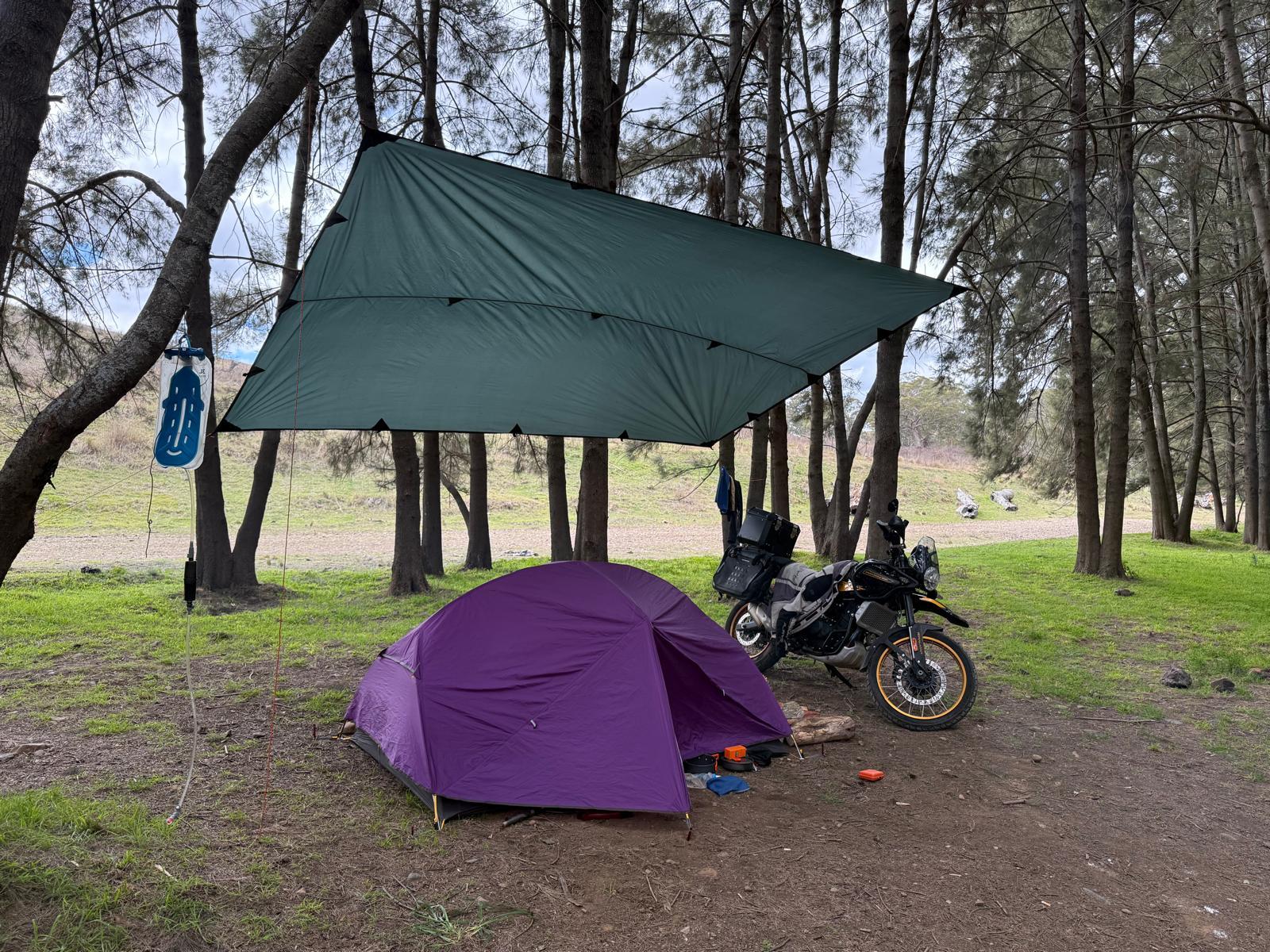
The bash plate, the frame, the case — the line of metal that stands between Hunter and the surface he is going to eventually meet.
The drop was on a slow corner on a Coromandel gravel track, maybe twenty kilometres an hour, the road dipping to a shallow stream. I had read the surface as hard-pack and it was hard-pack-over-loose, with the loose layer thick enough to wash the front out the moment I leaned. The bike went down on the right side, into ten centimetres of damp gravel. I caught my balance, stepped clear, and stood there for a moment looking at the shape of the thing. The engine was still running. There was no sound from the bike that worried me. There was a small indent on the right rally bar where the bar had taken the weight of the fall. There was no mark on the engine case. There was no mark on the radiator. The mirror, twenty centimetres above the bar, was unbent.
That is what crash protection is for. Not for the spectacular high-speed get-off you imagine when you are buying it, but for the slow, embarrassing low-side that happens to every dirt rider, eventually, on a corner they thought they had. The Royal Enfield rally crash protection on Hunter earned its keep on a corner I should have read better. This is the long-term review.
The short version
Buy the bash plate. Buy the rally bars. Add a third-party radiator guard if you are riding loose stones with traffic ahead of you. Skip the OEM headlight grill and use a B&B or SW-Motech if you can wait for shipping. The total is about A$700–900 depending on which pieces you take; on a 196-kg bike that you intend to ride on dirt, it is the first thousand dollars of upgrades that pays the largest dividend.
What it includes
Rally crash bars — A$389 from a Royal Enfield dealer. The bars are tubular steel, powder-coated black, and wrap from a frame mount near the engine forwards and up to just under the tank shoulder. They are designed to take a fall on either side and keep the tank, engine case, and cockpit off the ground. On the 450 they fit only the bike with the OEM rally headlight cowl — the standard Himalayan headlight needs a different cowl bracket. Confirm with your dealer before ordering.
Bash plate — included with rally crash protection on most builds; otherwise A$215 standalone. It is a single sheet of pressed steel, four millimetres thick, that bolts to the frame in three places and protects the engine case from below. Open at the back to vent heat and let the oil filter breathe. The factory plate is heavier than aftermarket aluminium options — 2.4 kg vs about 1.4 kg for the equivalent SW-Motech — but is also stiffer and quieter on rough terrain. I have not heard it ring once, even when running over loose stones.
Radiator guard — A$160. Mesh stainless, bolts to the radiator surround. The grade of the mesh matters: the Royal Enfield part has a fine enough grade to stop large stones and the mosquitoes that get up the front-fender gap on slow gravel. Cheaper aftermarket parts run a coarser mesh that stones get through. Stones happen. Buy the right one.
Headlight grill — A$160. Black plastic with a steel mesh insert, bolts to the cowl. This is the part of the protection package I have the most reservations about. It looks the part. It does its job. But the OEM headlight grill on the rally version of the 450 has a clip that loosens with vibration; mine has had to be retightened twice in twelve months. There are better aftermarket options for about the same money.
The full kit, mounted by the dealer when I bought the bike, came to roughly A$725. That includes labour, but not the handguards, which are a separate item I’ve reviewed — the Bark Busters Storm handguards are the ones I run.
What it earned, the day it earned it
The Coromandel drop was on the right side. The right rally bar took the entire fall. The frame, the engine case, the tank, the radiator, and the foot peg all stayed clear of the gravel. The bar has a small indent — about eight millimetres deep, three centimetres long — where the outer point of the bar met the surface. The powder coat is scuffed at that point and there is a fine line of bare metal showing through. The bar has not bent, not at the mount, not along its length.
The bash plate, on a separate occasion, caught a fist-sized rock at sixty in a wash on a logging road in the Tarkine. The strike was loud enough that I stopped and checked. There is a dent in the plate, maybe one centimetre across, two millimetres deep. The bolts were tight. The engine sump, which sits about fifteen millimetres above the dent, is unmarked. That is the kind of strike that, without the plate, would have cracked a sump and ended the trip.
The radiator guard has stopped a small handful of stones I never saw coming — you mostly notice it when you find a chip on the mesh that wasn’t there last week. The radiator behind it is unmarked.
Crash protection is not for the spectacular get-off you imagine when you buy it. It’s for the slow, embarrassing low-side every dirt rider has, eventually.
What it costs
Weight. The full kit adds roughly six kilograms to the bike. On a 196-kg machine, six kilograms is perceptible from a stop and barely noticeable above walking pace. If you live or die by spec-sheet weight, you’ll find aftermarket aluminium versions of all three pieces that save two to four kilos at twice the price. For the kind of riding the Himalayan was made for, the steel weight is the right call.
Cosmetic dent — permanent. The first drop puts a mark on the bar, and the mark is permanent. If the bike showing the history of where it has been is something you would dislike, this is information you should have before buying. I find it desirable. Hunter has a Coromandel dent. I know exactly where I got it. I prefer that to a bike that looks new and has never been anywhere.
The headlight grill, specifically. As above, the clip is fiddly and loosens. Plan to retighten it every six months.
Compared to alternatives
SW-Motech crash bars. Roughly A$580 for the Himalayan-specific kit. Lighter (about 1.5 kg total) and with cleaner welds. Mounts in different points, which means in a frontal impact the load path is different. I have not tested SW-Motech on this bike. Riders I trust who have say they are equivalent or slightly better in protection, with a noticeable cosmetic edge. For 50% extra money over the OEM kit.
Hepco & Becker. The German answer; A$650 install. Beautifully made, fitment is precise. Same functional category as SW-Motech.
OEM Royal Enfield rally protection (this kit).The cheapest of the three options. Comes with dealer-fit warranty. Designed by the people who designed the bike. For a bike at this price point, the OEM kit is the answer. If your bike is twice the price, look at the third-party options.
What I’d say to a Himalayan 450 owner
Fit the protection before the first dirt ride. If you have already done a few rides without it, fit it before the next one. The day you don’t need it is the day you forgot to install it. The cost is small relative to the bike, and modest relative to a single fairing repair. The tank panel on a Himalayan, replaced after a drop, is more than the full crash protection kit fitted.
I would specifically recommend, in order:
The bash plate first. The rally crash bars second. The radiator guard third. The headlight grill fourth, and optional — particularly if you are not riding behind other vehicles on gravel often. The bike at three thousand kilometres has all four; if I were buying again on a budget I would still prioritise in this order.
The slow drop is the test
The reason crash protection earns its money is not the spectacular crash. It is the slow, predictable, embarrassing drop — the one in the campground when the side stand sinks, the one on the gravel corner you read wrong, the one when you stop on a hill and your foot finds a loose stone instead of solid ground. Those are the drops that happen. Those are the drops a Himalayan 450 owner will have. The protection is for them.
I dropped Hunter slowly. The bike is unmarked except for a dent on a bar that is supposed to take dents. I rode out of there. I rode another six hundred kilometres that week. That is the result the protection bought me. Cheaper than the day I would have lost. Cheaper, by far, than the panel I would have had to replace. Wisdom requires scars; the bike is allowed to have a few too.
Where to buy it
Any Royal Enfield dealer in Australia, New Zealand, the UK, and most of Europe carries the rally protection kit, often bundled with the bike at purchase for a discount. In North America the OEM kit is harder to find at a discount; many riders default to SW-Motech or Hepco. Buy the OEM kit if you can; it is the right cost-to-protection ratio for the bike at this price. As ever, no affiliate codes here. I paid retail.
Questions a Himalayan 450 owner asks
Do I need crash bars on a Himalayan 450?
If you are going to ride it on dirt, yes. The Himalayan is light for a motorcycle and heavy for a dirt bike, and it is exactly in that gap that it falls over. Crash bars are for the slow drop, not the spectacular one. Fit them before the first dirt ride.
What is in the Royal Enfield rally crash protection kit?
Rally crash bars, a bash plate, a radiator guard, and a headlight grill. The bars are tubular steel, A$389. The bash plate is pressed steel, four millimetres thick, A$215 standalone or included with the bars on most builds. The radiator guard is mesh stainless, A$160. The headlight grill is A$160. The full kit, fitted by the dealer, came to about A$725 including labour. The handguards are a separate item.
Will they save the bike in a slow drop?
They did. I dropped Hunter on the right side at maybe twenty kilometres an hour on a Coromandel gravel corner. The right rally bar took the entire fall. The frame, engine case, tank, radiator, and mirror stayed clear of the ground. The bar has a small indent — eight millimetres deep, three centimetres long — and has not bent. I rode another six hundred kilometres that week.
Rally kit versus aftermarket — when would you pay more?
SW-Motech and Hepco & Becker make excellent kits for the Himalayan 450. Lighter, cleaner welds, about 50% more money. If your bike cost twice what a Himalayan costs, the upgrade is worth it. At this price point, the OEM kit is the right answer. It was designed by the people who designed the bike, it comes with dealer-fit warranty, and the protection it gives is the same protection the more expensive kits give.
What bent, and what didn’t, at Coromandel?
The right rally bar has an indent about eight millimetres deep where it met the gravel. The powder coat is scuffed, with a line of bare metal showing through. The bar has not bent. The bash plate, on a separate occasion in the Tarkine, caught a fist-sized rock at sixty and has a dent one centimetre across — the sump above it is unmarked. The radiator guard has stopped stones I never saw. The headlight grill is the weak point. The clip loosens with vibration and needs retightening every six months.
What’s next
The right rally bar will, eventually, take a second hit. I will replace it then rather than now — the function is unaffected and the cosmetic mark is, on this bike, an improvement. The bash plate I will probably run for the life of the bike. The radiator guard I will refresh if the mesh ever fatigues. The headlight grill I am replacing, when I can be bothered, with a B&B aftermarket part. I will write that up when I do.
In the meantime: if you have just bought a Himalayan 450 and you have not yet bolted protection on it, do that first. Tyres second. The Mitas Enduro Trail XT Dakar is the right second purchase. The seat third — the Royal Enfield adventure seat is the one I’d fit. The protection is the right first one.
Get the next one
Twice a month. The next verdict and the next journey land here first — photographs, and where I’m headed next.