DNA Stage 2 air filter — what changed when I opened the airbox.
The exhaust note. The first quarter of the throttle. The quiet, reluctant lump in the middle of the rev range, gone. A long-term review of the DNA Stage 2 air filter and intake cover on a Royal Enfield Himalayan 450.
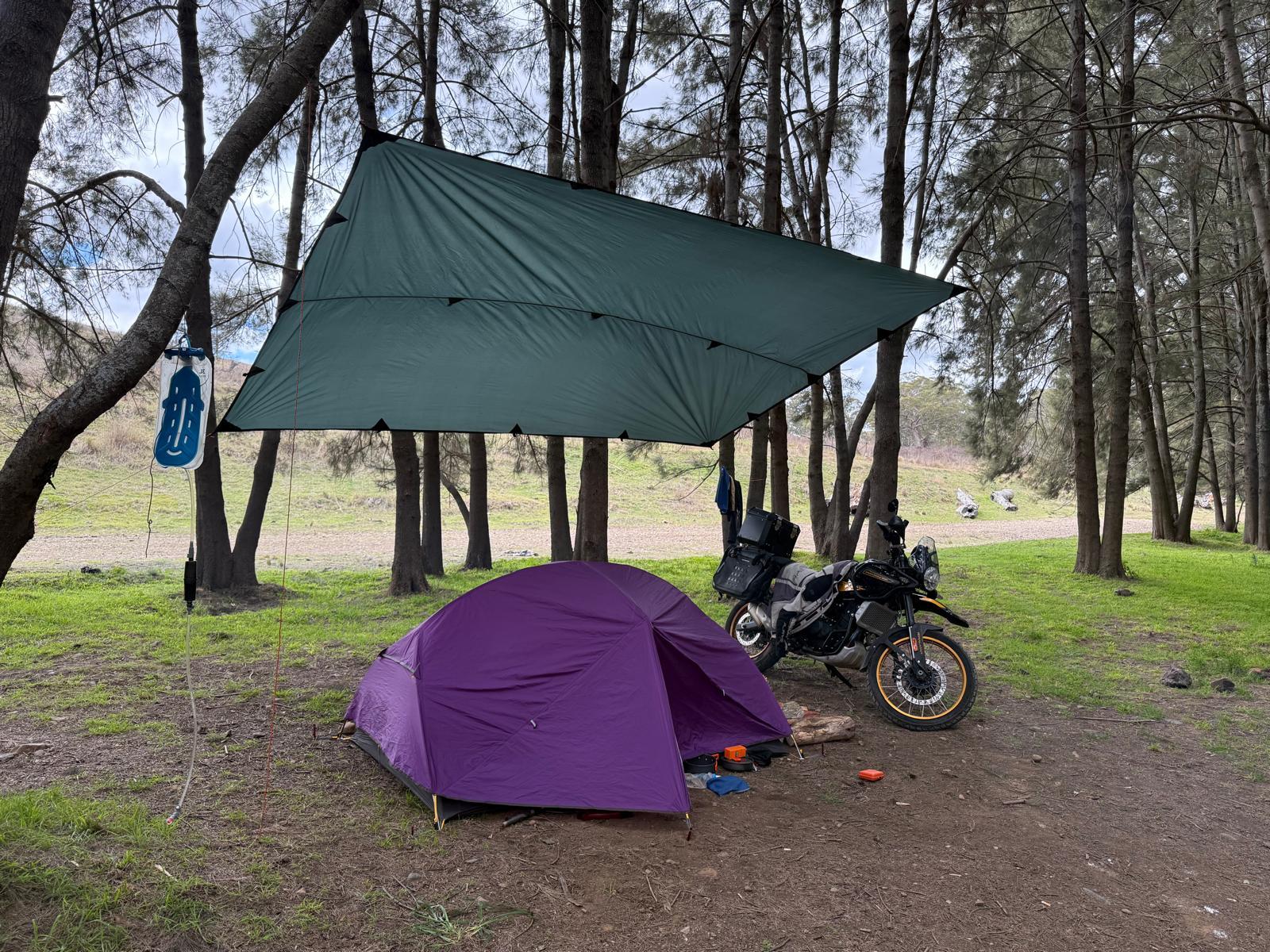
The 452 cc single, three months after the airbox came open. The filter is hidden under the right-hand cover; the work it does is everywhere on the rev counter.
The first time I rode the bike with the DNA Stage 2 fitted I was at Motociclo, in Sydney, picking up a long list of accessories. They had done the install while I had a coffee. I left the workshop, turned out into King Street, and twisted the throttle to make a gap in the traffic. The bike answered the throttle the way bikes are supposed to. That sounds like a small thing. On a Royal Enfield Himalayan 450, the small thing was the difference between a bike that politely got out of its own way and a bike that, for the first time, wanted to go.
The DNA Stage 2 is a high-flow air filter and intake cover for the Himalayan 450. It is made in Greece, sold by DNA Filters direct and through a small distribution network (in Australia, Procycle Imports; in NZ, MotoMail). The part is two pieces: a cotton-gauze filter element that replaces the OEM paper filter, and a slotted plastic intake cover that replaces the OEM cover with one that flows considerably more air. Together, the kit is roughly A$239 and takes a good mechanic about thirty minutes to install.
I have ridden roughly nine thousand kilometres with the DNA fitted, on a 2025 Himalayan 450, across the same mix of seal, gravel, and mixed riding I describe in everything else on this site. This is what the air filter has done to the bike.
The short version
Buy it. It is, in my view, the single best A$239 you can spend on a Himalayan 450. It transforms the throttle response in the first quarter, fills the small flat spot the OEM filter has at 4,500 rpm, and changes the exhaust note from a polite single to something that sounds like the bike Royal Enfield meant to build. There is no measurable downside that I have found.
What it earns
Throttle response in the first quarter. The OEM filter strangles the bike below 4,000 rpm. The bike starts in cleanly, but the first quarter of the throttle feels like a separate machine to the second — you twist, the bike thinks, then it goes. With the DNA in, the gap between input and answer is gone. The bike accelerates from idle the way a single is supposed to: with a small, rising thump that gets to your right wrist before it gets to the road.
The 4,500 rpm flat spot. Stock, the 450 has a small reluctance at around 4,500 rpm — you feel it most rolling on through fifth gear at about ninety kilometres an hour. It is not a misfire. It is the kind of soft moment in the rev range where a bike is asking its airbox a question its airbox cannot quite answer. The DNA fills it. The roll-on is smooth.
The exhaust note. This is what most riders will notice in the first hundred metres. Stock, the Himalayan 450 sounds like a polite scooter that has gone to university. With the DNA opening the intake, the exhaust note — same OEM pipe, no other changes — gains about thirty per cent more bark in the mid-range. It is still legal-quiet at idle and at low revs. Above 5,000 rpm, it sounds like the kind of single you would buy on purpose.
It costs nothing in fuel economy. I tracked kilometres-per-litre for a thousand kilometres before and a thousand kilometres after, on the same routes, same loads, same speeds. Before: 28.4 km/L average. After: 28.6 km/L. Inside the noise. The bike is not richer or leaner enough to matter.
Stock, the Himalayan sounds like a polite scooter that has gone to university. With the DNA in, it sounds like the bike Royal Enfield meant to build.
What it costs
The price. A$239, plus A$70 install if you are not doing it yourself. Cheaper aftermarket filters exist — K&N, Pipercross, even the AKM kit out of India. None of them, in my experience or in the conversations I have had with mechanics who have seen all of them, do quite what the DNA does on this engine. The flow numbers DNA publishes are higher; the on-road feel matches the numbers.
Cleaning, eventually. The DNA is a cotton-gauze filter. It is reusable. Every five thousand kilometres or so, you take it out, blow it through with compressed air or wash it gently with the DNA cleaning fluid, and re-oil it with the DNA filter oil. The whole process takes twenty minutes. It is not a chore; it is the kind of small, deliberate maintenance the Himalayan invites. I quite enjoy it. If you don’t, the price of a service that does it for you is roughly the same as replacing an OEM paper filter every twenty thousand kilometres — cost-neutral over the life of the bike, and probably better.
The legality question. In Australia and New Zealand, an aftermarket air filter and intake cover do not need to be ADR-approved or LVVTA-certified the way an exhaust does. The DNA is, as best I have been able to confirm, fully legal in both countries. The OEM warranty on the bike is a different question; some dealers will void engine cover for a non-OEM intake part, others will not. Mine has not. Your mileage, and your dealer, may vary.
How it compares
OEM paper filter. What it replaces. The OEM works. It is fine. It is engineered to a price point and a homologation target. The DNA is engineered to a performance target. If you bought a Himalayan 450 to ride to work and back, the OEM is fine. If you bought a Himalayan 450 because you intend to go places, the DNA earns its keep on the throttle alone.
K&N. Roughly A$120 for the filter element alone. No matched intake cover; you keep the OEM cover. Marginal flow improvement, marginal noise change, marginal throttle change. If you were to put it on the bike I just took it off, you would be glad of it. Compared to the DNA, you would feel every dollar of difference.
BMC. Comparable to the DNA, in the same price range, slightly different filter media. I have not run a BMC on this bike. Riders I trust who have say the difference between BMC and DNA is taste, not performance.
What I’d say to a Himalayan 450 owner
If you have only one performance-oriented modification in the budget, this is the one. It is cheaper than tyres and changes how the bike feels at every speed below ninety. It is much cheaper than an exhaust and changes the exhaust note enough that most people stop wondering about an exhaust.
If you are stacking modifications — air filter, cruise control, GPS, tyres, protection — do the air filter first. The other things make the bike better; the air filter makes the bike correct. Everything else is additive on a corrected baseline.
The DIY question
The install is, by Royal Enfield standards, easy. Two bolts on the right-hand side cover, a clip on the airbox lid, the OEM filter slides out, the DNA slides in, the new intake cover bolts up in place of the OEM. Thirty minutes if you have done it before, an hour if you haven’t. The DNA arrives pre-oiled. Re-oil with the DNA-specific oil only; do not improvise with K&N oil, which has a slightly different solvent profile and can leave a residue on this filter media.
If you are doing your own service intervals already, do it yourself. If you are paying a dealer, ask them to fit the DNA at the next service and you will save the labour.
Where to buy it
In Australia, Procycle Imports is the importer; major accessory chains stock it but the price is best direct or via Motociclo / accessory specialists. In New Zealand, MotoMail. In the UK and Europe, DNA Filters direct and most dual-sport specialists. North America: Twisted Throttle and equivalent. There is no affiliate relationship between this site and DNA. I paid retail.
What’s next
The next step in this direction would be a remap or a power commander to take advantage of the extra airflow. I have not gone there yet, and I may not. The bike is, with the DNA fitted and the OEM exhaust, where I want it for the kind of riding I do — long days, mixed surfaces, conservative pace. A remap on top of the DNA would gain another two horsepower and maybe a torque point. It would also lose the bike a little of its honesty. I am inclined, for now, to leave it.
In the meantime: if you have a Himalayan 450 and the first quarter of the throttle annoys you, the DNA Stage 2 is the answer. Two hundred and thirty-nine dollars. Thirty minutes. The bike comes out of it sounding, finally, like the bike it was supposed to be.
Get the next one
Twice a month. The next verdict and the next journey land here first — photographs, and where I’m headed next.