Veridian cruise control — the small lever that gives you your wrist back.
A long-term review of the Veridian throttle-lock cruise control on a Royal Enfield Himalayan 450. Pacific Highway days, the moment the right wrist stops being part of the problem, and what A$506 buys on a small bike.
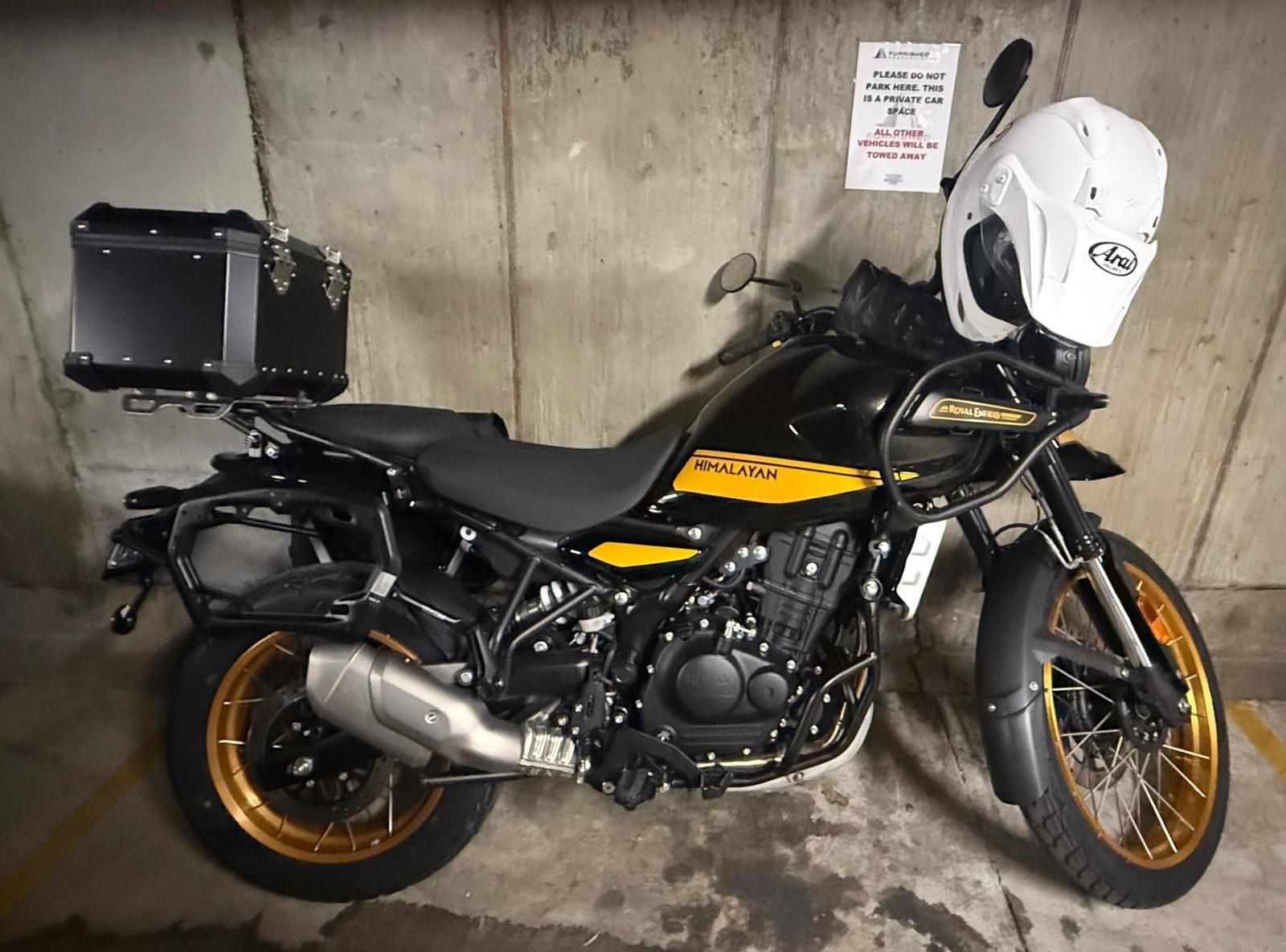
Hunter, fully loaded, before the Pacific Highway run to Coffs. The small black lever on the inboard side of the brake-lever housing is what makes a five-hour day a four-hour day for the wrist.
The first time the Veridian earned its keep was on the long flat stretch of the Pacific Highway between Buladelah and Macksville — about three hundred and twenty kilometres of three-lane single carriageway, almost no hills, almost no corners, the speed limit one-ten the whole way. I had set the cruise to one-oh-five thirty kilometres into the day. Two hours later I realised I had not actually thought about my right hand for ninety minutes. The wrist had stopped being part of the problem. The bike had stopped being a thing I was holding on to and had become a thing I was sitting on. That is what the Veridian is for.
The Veridian Cruise is a mechanical throttle-lock cruise control. It is not electronic. It does not care whether your bike has ride-by-wire (the Himalayan 450 does not). It is a small lever that bolts to the inboard side of the right-hand switch cluster and, when you push it down with your thumb, it locks the throttle in its current position. To release: a quarter-turn of the throttle, or a tap on the front brake. The whole device is two pieces, weighs maybe one hundred and fifty grams, and is one of the few accessories on the bike that does its job without ever drawing attention to itself.
I have run it for ten months on a 2025 Royal Enfield Himalayan 450, across roughly twelve thousand kilometres of riding that includes most of the long highway days I have done since the bike arrived. This is the long-term review.
The short version
Buy it if you ride more than two hours at a time on highways or quiet country roads. Don’t buy it if your riding is mostly twisty, urban, or technical. On the Himalayan 450 specifically, where the bike runs out of mid-range and asks the rider to hold the throttle at a fixed point for a long time, the Veridian is not a luxury. It is the difference between a long day and a very long day.
What it earns
The right wrist gets a rest. The single most important thing it does. A small motorcycle at highway speed asks the rider to hold the throttle at the same fixed point, against a return spring, for hours. The hand goes from neutral to fatigued at about the ninety-minute mark. With the cruise locked, the hand goes back to neutral, the forearm relaxes, the shoulder drops, and the rider rides the bike instead of fighting the bike.
It works on hills. The Veridian is purely mechanical, so it does not adjust speed for grade the way an electronic cruise does. Going up a hill the bike slows, going down a hill the bike speeds up. On the Himalayan’s power output, the variation is real but small — about ten kilometres an hour either side on a steep grade. For long Australian and New Zealand roads, where most highway grades are modest, this is not a deal-breaker. On the Snowy Mountain pass it would be more noticeable.
The release is instinctive. Tap the front brake lever and the cruise releases. Roll off the throttle a quarter turn and the cruise releases. Touch the clutch and the cruise releases. There is no separate disengage button. There is nothing to remember. The bike does what your reflexes already do.
It will hold a precise speed. The throttle tension is enough that, once locked, the throttle does not creep. I have measured it with the speedo and the GPS in agreement: locked at 105 km/h, the bike held within plus-or-minus one km/h on flat seal for hours. That is more precise than I can hold the throttle myself.
The wrist had stopped being part of the problem. The bike had become a thing I was sitting on, not a thing I was holding.
What it costs
The price. A$506. That is real money for what looks, on the bench, like a small black lever and a friction plate. The premium is in the engineering: the Veridian sits flush, does not interfere with the brake or throttle housings, and does not loosen with vibration the way cheaper throttle-locks do. I have run the cheap ones (Throttle Rocker, Cramp Buster, Vista Cruise) on previous bikes and they all, eventually, slip, loosen, or get in the way of the brake lever. The Veridian doesn’t.
The grade limitation. As above. On flat to moderate roads, fine. In serious mountains, you will still be modulating the throttle on the climbs, which somewhat defeats the purpose. If you live in Tasmania’s central highlands or Wellington’s southern coast, factor this in.
It is a single-position cruise. No accelerate-or-decelerate-from-the-cruise feature. To change set speed, you release the cruise (front brake or throttle roll-off), accelerate to the new target, and re-set. This takes about three seconds. It is not a real cost; it is a quirk to learn.
The Pacific Highway day
Sydney to Coffs is six hundred kilometres on the M1 and the Pacific Highway. I have ridden it in summer with the Veridian fitted (June 2025) and I have ridden it before the Veridian was fitted (May 2025, on a previous bike) and the difference at the end of the day is, in plain terms, ninety minutes. Not in elapsed riding time — in the time it takes to feel like a human being again afterwards. With the Veridian, I walked into the motel at Coffs at six in the evening and was reading a book by seven. Without the cruise, the same day ended with my right wrist on a hot-water bottle and dinner ordered to the room.
How it compares
Throttle Rocker / Cramp Buster. Twenty dollars. A foam wedge that sits on the throttle and lets you rest your palm on it. Useful for a half-hour. Not a cruise; just a comfort aid. For a small budget, fine. I would not buy one again.
Vista Cruise. A$120. A friction-style throttle lock that mounts under the bar end. Cheaper than the Veridian, slightly fiddlier to engage and disengage. Riders I trust who have used both say the Veridian is cleaner, the Vista is most of the way there at a quarter of the price. If A$506 is hard, the Vista is a defensible compromise.
Atlas Throttle Lock. Closest competitor. About A$390. Engages off a thumb-paddle, similar build quality to the Veridian. A bit larger on the bar cluster, slightly more visible. If your dealer cannot source the Veridian, the Atlas is the equivalent answer.
Electronic cruise (factory or aftermarket retrofit).The Himalayan 450 does not have ride-by-wire, so a factory-style electronic cruise is not on the table. For bikes that do, electronic cruise solves the grade problem the Veridian doesn’t. For bikes that don’t, the Veridian is what you have.
What I’d say to a Himalayan 450 owner
If your weekend riding is the local twisties, skip the cruise. The Veridian is not for the road that has corners every kilometre. If your riding includes any kind of long-distance day — the Pacific Highway, the Hume, the Kaipara coast road, the long stretches between fuel stops in the centre of either country — the Veridian pays for itself the first time you use it for ninety minutes straight.
In the order I would prioritise modifications: air filter first, tyres second, protection third, the Veridian fourth or fifth. It is not the most important upgrade. It is the upgrade that, on a long day, you most miss when it’s not there.
The DIY question
The install is straightforward. Two M5 bolts hold the right-hand switch cluster together; the Veridian sits between them. Total time, including reading the instructions: forty-five minutes. Tools: a Phillips screwdriver and a 4mm hex key. No wiring. The hardest part is not stripping the M5 bolts on the OEM cluster — they are torque-spec, and over-tightening on re-install will damage the threads. Hand-tight, then quarter-turn with a 4mm key. That is enough.
Where to buy it
In Australia, AdventureRiderEquipment in Brisbane stocks the Veridian at the best price I have found locally. Procycle.com.au and a couple of the larger accessory chains also carry it. In the UK and Europe, Adventure Spec carries the European-spec version. North America: Veridian direct, and through Twisted Throttle. There is no affiliate relationship between this site and Veridian. I bought my own.
What’s next
The next long highway day is from Auckland to Wellington via the Forgotten World Highway, which is a mix of highway and twisty backroad — the kind of day where the Veridian earns its keep on the highway third and politely steps aside on the rest. I will write about the Forgotten World Highway separately. The Veridian I will not need to write about again. It is one of those modifications you bolt on, forget about, and silently thank for the rest of the bike’s life.
In the meantime: if you have ever ended a five-hour ride day with a right wrist that wants to be left alone for an hour, the Veridian is the answer to a question your body has been quietly asking. Bolt it on. Forget it.
Get the next one
Twice a month. The next verdict and the next journey land here first — photographs, and where I’m headed next.