Mitas Enduro Trail XT Dakar — three thousand kilometres on a 60/40 tyre.
Wet clay near home. The Bass Strait. The gravel between Bathurst and Hill End. What the Mitas Enduro Trail XT Dakar earns, what it costs, and what it asks of the rider.
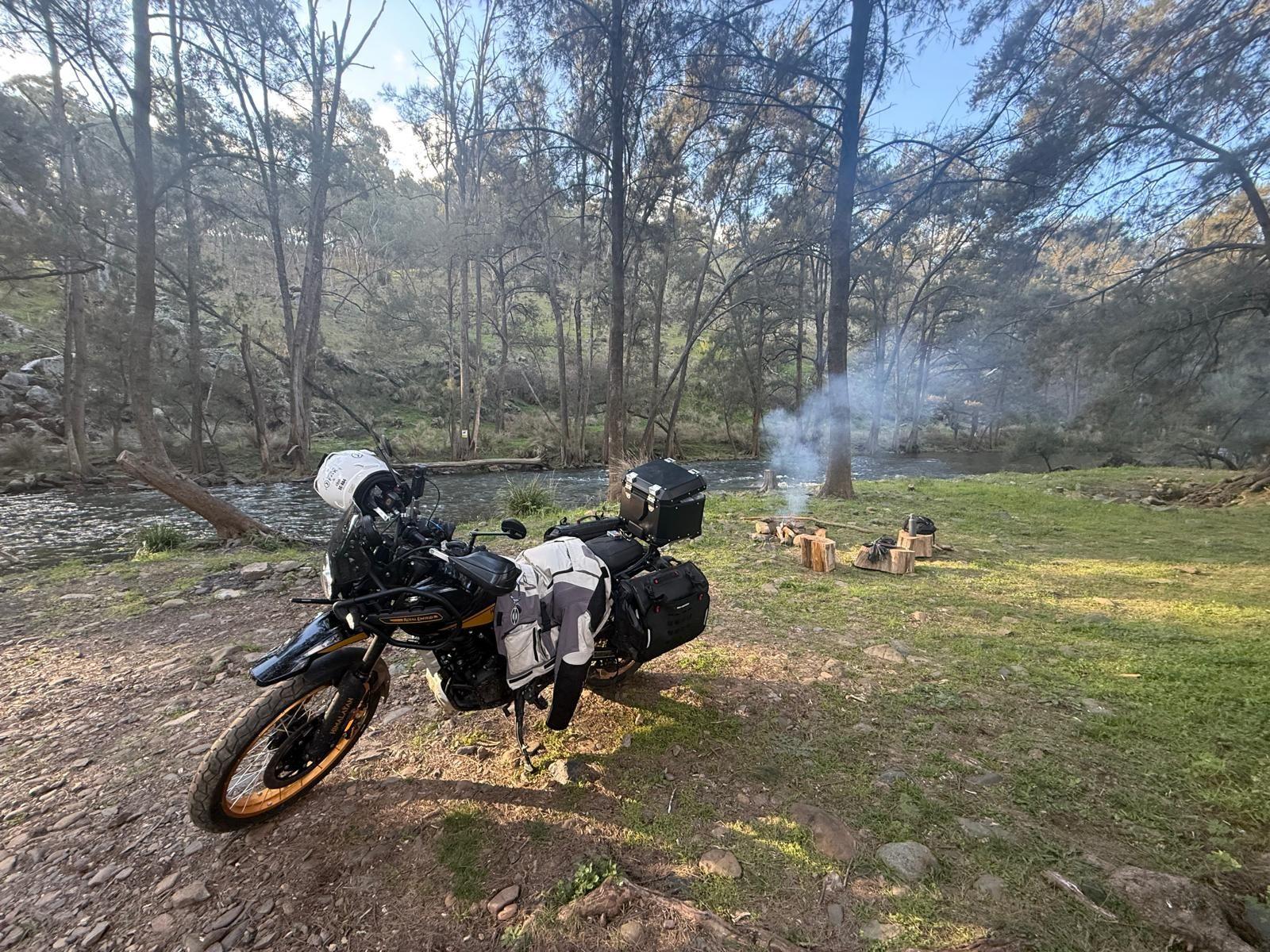
Hunter beside a creek on the run home. The tread still carrying the morning’s clay; the carcass still cold from the river.
The first time I trusted the Mitas Dakars I was on a section of unsealed road near home that, after rain, takes on the colour of milky tea. The previous tyres — the stock CEATs — made that road into a long question I was tired of answering. I fitted the Mitas in October. By November I had ridden the same road in worse weather and stopped thinking about it. That, in the end, is the highest thing you can say about a tyre. You stop thinking about it.
The Mitas Enduro Trail XT Dakar is a 60/40 dual-sport tyre — sixty per cent dirt, forty per cent road, in the shorthand the industry uses to mean nothing precisely and everything roughly. On the Royal Enfield Himalayan 450, the fitment is 90/90-21 front and 140/80-17 rear. I bought a pair from MCAS in Sydney; the front was $240 and the rear $320. Fitting was another sixty per wheel through Motociclo. Total, with TPMS valves, around six hundred and fifty dollars on the road.
I have ridden them, at the time of writing, roughly three thousand kilometres — mixed seal and gravel between Sydney, the central west of New South Wales, the Spirit of Tasmania crossing, the gravel logging roads of north-west Tasmania, and now the clay back roads out of Pahi in Northland. They are the second tyre I have ever spent money on with my own money rather than inherited from a previous owner. They are not the last tyre I will buy.
The short version
The Mitas Enduro Trail XT Dakar is a good tyre that is a pain to fit on the Himalayan 450. If you are willing to remove the front lower mud guard and faff about with the fitment, you get a tyre that handles wet clay and gravel with real composure. If you are not willing to do that, do not buy them for this bike. The tyre is not the problem — the fitment is.
What they earn
Composure on wet, mixed surfaces. The single biggest difference between the Mitas and the stock CEATs is the way they behave on the half-second between dry seal and wet clay — the bit where one tyre goes “noted” and the other goes “oh.” The Mitas just stays on the line you asked for. The block pattern is aggressive enough to bite into the surface rather than skate across it, but the blocks are tied together by enough rubber that they don’t feel squirmy when the surface goes hard again.
Predictability under braking on gravel. One of the things you learn in an adventure-bike course is that the front tyre on dirt should be allowed to lock for a fraction of a second under braking — the small wheel-dig into the gravel slows the bike better than ABS allows. The Mitas front lets you feel that. The CEAT didn’t. The feedback through the bars is a quiet, continuous report of what the surface is doing.
The river crossing. On the way to Sofala, on Razorback Ridge, there is a section where the road drops into a creek and the creek bed is loose stone for ten metres before the climb out. I crossed it heavy — the bike loaded for three days — and the rear Mitas held the line through gravel I would not have trusted on the stock tyre. The carcass is stiff enough that the bike doesn’t squirm under load, which on a 196-kilo wet bike loaded with another forty kilos of kit is the difference between a crossing and a recovery.
The Mitas just stays on the line you asked for. That is what you are paying for.
What they cost
The fitment. This is the part I did not talk about enough when I first wrote this review, and it is the part that matters most on the Himalayan 450. The front Mitas — the 90/90-21 — is tight against the lower mud guard. To run it properly, I had to remove the front lower mud guard and faff about with clearance. That is not a small thing. It is the difference between a tyre that works and a tyre that rubs on every bump. If you are not willing to do that work, or pay someone to do it, do not buy these tyres for this bike. I cannot put it more plainly than that.
Road noise above ninety. On a smooth bit of seal at one-ten the Mitas hum. The hum is not loud, but it is there, and on a long day it adds a small tax to the cabin — if a motorcycle can be said to have a cabin. With the stock screen and earplugs it is a non-issue. Without earplugs, on a touring stretch from Geelong to Devonport, you notice it after the first hour.
Wear, on the rear, in the centre. Three thousand kilometres in, the rear tyre has flattened slightly in the middle — classic touring wear from highway miles between destinations. The shoulders, where the dirt work happens, are still sharp. I expect a real-world life of around eight to ten thousand kilometres on the rear, and twelve to fifteen on the front. That is not Pirelli MT21 lifespan and it is not Heidenau K60 lifespan; it sits closer to the K60 if you keep it off long highway stretches.
Pressure sensitivity. The Mitas like to be run a little softer than the OE tyre on dirt — I run 28 PSI front and 30 rear off-road, 32/36 on seal. Get this wrong on a long mixed day and the wear is noticeably uneven. I run a Bluetooth TPMS for thirty-seven dollars; on a tyre this picky about pressure, the TPMS pays for itself quickly.
How they compare
I have not run the Pirelli Scorpion Rally STR or the Continental TKC 70 on this bike, so this is not the head-to-head review you might be looking for. What I can say:
Against the stock CEAT Gripp XL: the Mitas is a clearly better tyre on every surface I’ve ridden, with the small cost of road noise. The CEAT is the cheapest tyre on the bike for a reason; it is fine on dry seal and nervous on everything else. Replace it.
Against the Heidenau K60 Scout: the Mitas has more dirt bite at the cost of slightly worse seal life. If your weekend ride is the Bridle Track and your weekday ride is a twenty-minute commute, the Mitas wins. If you are riding from Sydney to Cairns mostly on the Bruce Highway, the K60 wins.
Against the Mitas E-09 Dakar (the more aggressive sibling): I have not run the E-09. Riders I trust who have say it is louder, shorter-lived on tarmac, and noticeably better in deep mud. For my mix — ninety per cent of which is hard-pack gravel, clay, and seal — the Enduro Trail XT is the right step down.
The Tasmania crossing
I crossed the Bass Strait on the Spirit of Tasmania in March, day nine of a thirty-day fast, and the bike rode off the boat with about fifteen hundred kilometres on the Mitas already. Tasmania’s back roads are the kind of mixed surface the tyre was made for — the long gravel stretches between Cradle Mountain and the west coast, the wet clay through the Tarkine, the loose metal of the logging roads up to the Pieman River. Everything the Mitas could be asked, Tasmania asked it. The tyre held.
The one moment of nervousness was on a steep downhill in Cradle Mountain National Park, late afternoon, the surface loose gravel over wet clay over rock. I locked the front under brake-and-engine deceleration and the bike stayed pointed; the tyre dug, then released, then dug again. On the CEAT I would have washed out. The Mitas asked the question and answered it before I had finished worrying.
What I’d say to a Himalayan 450 owner
Here is the honest truth. The Mitas Enduro Trail XT Dakar is a good tyre. I trust it offroad. It looks good on the bike. But fitting it to the Himalayan 450 is not straightforward — you need to remove the front lower mud guard and work through the clearance, and that is a genuine consideration, not a footnote. I rated these tyres 5 out of 10 for this bike, and the reason is simple: a tyre that requires you to modify the bike to run it is a tyre you need to think hard about before you buy.
If you ride hard dirt and you do not mind the fitment work, the Mitas gives you composure and grip that the stock CEAT cannot. If you want a tyre that bolts on and goes, this is not that tyre — not on this bike. That is the consideration people need to know.
The other half of the same advice is that a tyre is not a skill. A better tyre will let you go further into a corner with less attention; a better tyre will not stop you crashing if you ride beyond what the tyre and the surface and the rider together can offer. I dropped the bike on a Coromandel gravel track in March on these tyres, going slowly, on a loose surface I had misread. Wisdom requires scars. The tyre was not the variable.
Where to buy them
In Australia, MCAS in Sydney had stock when I bought mine and the price was the best I found. In New Zealand, MotoMail (NZ Mitas distributor) ships nationally; pricing is a touch higher than Australia and stock is sometimes thin on the 21-inch front. In the UK and Europe, the tyre is widely available through any dual-sport specialist. In North America, the equivalent is the Mitas Enduro Trail XT Plus, which is functionally identical with a slightly different sidewall compound.
I do not have an affiliate code with anyone. I bought my own tyres. If a tyre review online has a discount code at the bottom, that is a thing for you to factor into your reading of it.
What’s next
The rear will need replacing somewhere around the eight-to-ten thousand kilometre mark, which on the current rate of riding puts it in late winter 2026. I am planning to run another Mitas Enduro Trail XT on the rear and step the front down to a more aggressive pattern — the Mitas E-09 Dakar — for the Northland coast roads, which run more clay and less seal than I had been riding in NSW. I will write the comparison when I have ten thousand kilometres on the new setup. Probably late 2026.
In the meantime: if you have a Himalayan 450 and you are considering these tyres, go in with your eyes open. The Mitas is a good tyre that handles offroad with real composure, but the fitment on this bike is a genuine hassle — removing the front lower mud guard, working through clearance issues. It is not a bolt-on-and-go upgrade. If you are willing to do the work, you get a tyre I trust in the dirt. If you are not, there are tyres that fit easier and ask less of you. That is the honest truth of it.
Get the next one
Twice a month. The next verdict and the next journey land here first — photographs, and where I’m headed next.