Bark Busters Storm — handguards that quietly do their job.
Cold mornings on the Bridle Track. A low branch in the Tarkine. The slow drop on Coromandel. A long-term review of the Bark Busters Storm handguards on a Royal Enfield Himalayan 450.
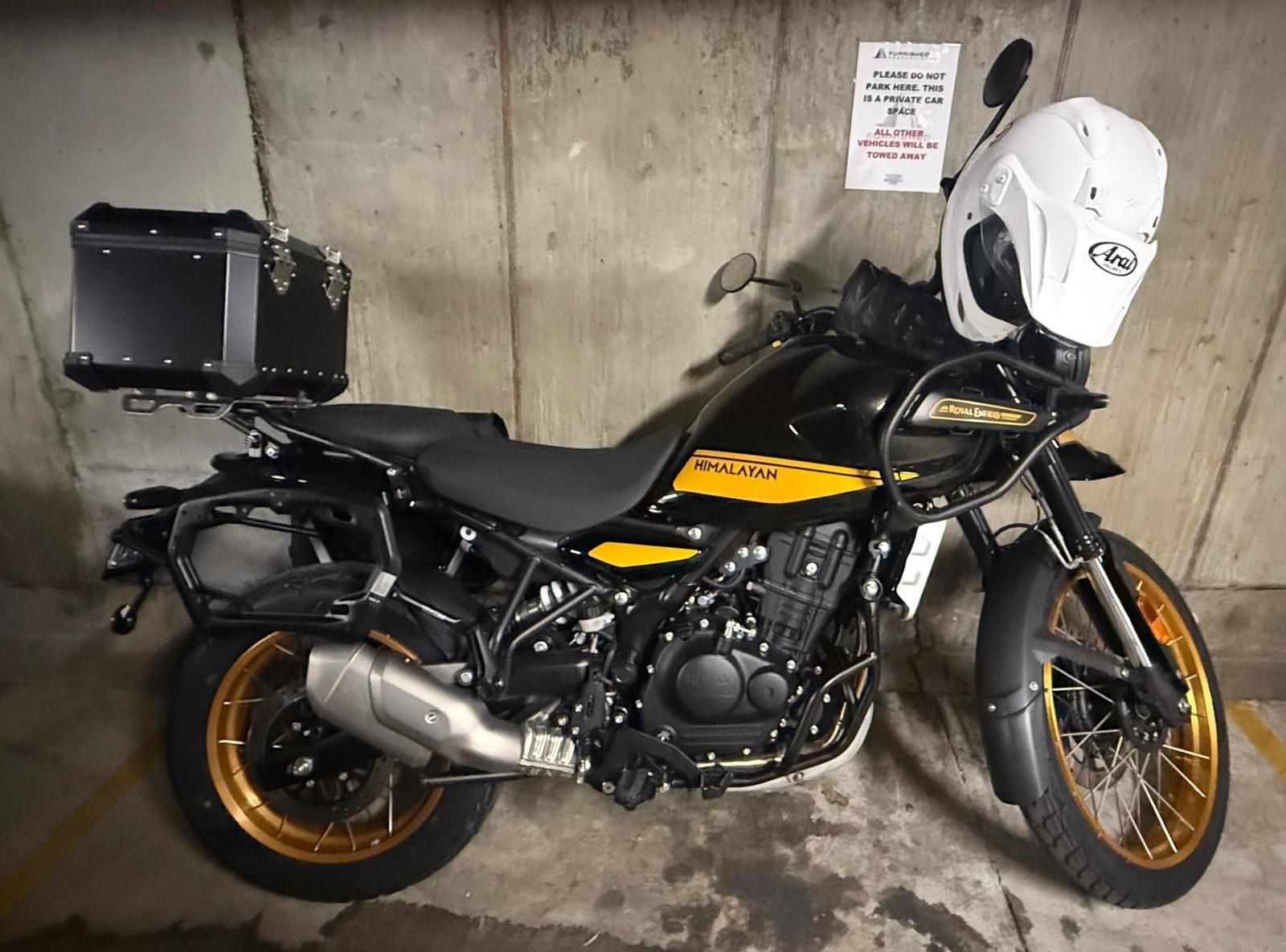
The Bark Busters Storm guards on Hunter, before a long cold morning. The aluminium spine runs from the bar end to the inboard mount; the plastic deflector handles the wind.
The Bark Busters Storm handguards on Hunter have been with me for ten months and roughly twelve thousand kilometres, and they have done three jobs. They have kept the wind and the cold off my hands on dawn starts where the ambient was four degrees. They have stopped a low branch on a narrow Tarkine track from putting a finger on the front brake at twenty-five kilometres an hour. And on a slow drop on a Coromandel gravel track in March they took the impact of the bars hitting the ground without bending the bar, the lever, or my hand. Three jobs, ten months, two hundred and twenty Australian dollars. They have, by any reasonable measure, paid for themselves.
The Bark Busters Storm is a two-piece handguard system: an aluminium-alloy backbone that bolts from the bar end to an inboard chassis mount, and a black thermoplastic wind deflector that bolts to the backbone. The whole thing is engineered as a structural system — the backbone is the part that takes a fall, the deflector is the part that handles the wind. They are made by BHG (Bark Busters Hand Guards) in Australia, sold direct and through specialist motorcycle accessory shops worldwide.
The short version
Buy them if you ride in any kind of cold weather, in any kind of forest, or off any kind of seal road. The Storm is the right Bark Busters model for a Himalayan 450 — the cheaper VPS series have less crash protection, and the more expensive Sabre series is over-engineered for a 196-kilo bike. The Storm is the correct middle. A$220 fitted is fair money.
What they earn
Cold morning protection. This is the first job and, for most riders, the most important. At ambient temperatures below ten degrees, the wind chill on uncovered hands at one hundred kilometres an hour is brutal — even with the best winter gloves, the hands go numb in twenty minutes. The Storm deflector breaks the airflow ahead of the throttle hand. With winter gloves and heated grips behind it, four degrees becomes survivable for a long ride. Without the deflector, four degrees becomes twenty kilometres before you stop and get warm.
Branch and brush protection. On any kind of narrow track — the Bridle Track, the Tarkine logging roads, the unsealed sections in the Watagans — low branches and undergrowth slap at the bars on the way past. Without handguards, those slaps land on your hands or on the levers. With them, they land on the deflector. I have had several — one of them on the Watagans run that would have, without the guards, almost certainly caught a finger on the brake lever and sent the bike into a soft front-end stop. The deflector did its job; I never noticed the branch had touched the bike.
Slow-drop crash protection. The Storm’s aluminium backbone is the structural piece. On the Coromandel drop, the bike went down on the right side. The bar end met the gravel through the bar-end mount of the Storm. The Storm took the load. The bar did not bend. The clutch lever (left side, opposite to the drop) was untouched anyway; the brake lever (right side) was protected by the inboard portion of the Storm and unbent. The bar-end mount has a cosmetic scuff on the right; otherwise the Storm is undamaged.
Hardware engineered for a real fall. The difference between Bark Busters and the cheaper wind-only handguards (the OEM-style plastic flaps you see on a lot of Adventure-segment bikes) is that the Bark Busters backbone is rated for fall loads. The cheap plastic guards bend or shatter on the first drop. The Bark Busters take the load.
Three jobs, ten months, two hundred and twenty dollars. They have, by any reasonable measure, paid for themselves.
What they cost
Width. The Storm guards add roughly forty millimetres of width on each side of the bars. On a wide adventure bike this is invisible. On a Himalayan 450, which has reasonably wide bars to begin with, the extra eighty millimetres total can catch on a doorway or a tight gap if you’re used to walking the bike through narrow spaces. I have hit a doorframe once, in a hostel garage, in the dark. No damage. My own fault.
Cosmetics. The Storm in matte black looks right on Hunter. The Storm in red, blue, or yellow looks busier. If aesthetic continuity matters to you, order black. If you ride a brightly coloured bike and you want to match the bodywork, the colour options are there.
The price. A$220 is the right side of fair. The Storm is the lower-mid tier of the Bark Busters range; the higher tiers (the Sabre, the EGO) are A$320 and A$420 respectively. For a Himalayan 450, the additional crash performance of the higher tiers is overkill. Save the money.
How they compare
OEM Royal Enfield handguards. Plastic only. No aluminium backbone. About A$130. Wind protection comparable to the Storm; crash protection significantly worse. If you only ride dry seal in warm weather, the OEM is fine. If you ride dirt, get the Bark Busters.
Acerbis Endurance-X. Roughly the same money as the Storm. Lighter, more enduro-oriented, less wind coverage. If you ride more single-track and less long-day touring, Acerbis is a defensible alternative. For mixed riding, the Storm has the better wind protection.
Cycra Probend CRM. Roughly A$280. The competition standard. Slightly stiffer aluminium backbone, slightly larger deflector. If you are riding hard enduro, Cycra. If you are riding adventure-touring, Bark Busters.
Barkbusters JET. The lower-tier from BHG themselves. Same backbone as the Storm, slightly smaller deflector. About A$190. I would buy the Storm over the JET for the additional wind coverage alone. The price difference is marginal.
What I’d say to a Himalayan 450 owner
Fit handguards. The Bark Busters Storm is the right one. If you cannot find the Storm specifically, the JET is the same backbone with a smaller deflector; fine for a warmer climate, less good for cold mornings. The order I would prioritise modifications, now updated: air filter, tyres, crash protection, handguards, cruise control. Handguards land in the middle of the priority list because they do three different jobs — cold, branches, and crash — and on a small adventure bike, you will need all three eventually.
The DIY question
The install is straightforward but fiddly. The aluminium backbone bolts to the bar end (replacing the bar-end weight) and to the chassis at an inboard clamp. The OEM bar-end weight has to come off; the Storm includes a replacement bar-end. Total time: about an hour. Tools: a torque wrench, a 5mm hex key, a 14mm spanner. The trickiest part is getting the inboard chassis mount in the right position so the guards sit parallel to the road. Mark the bar before you tighten anything.
Where to buy them
In Australia and New Zealand, BHG.com.au direct, and every adventure-bike accessory shop. In the UK and Europe, Adventure Spec and Bike Stop. In North America, Twisted Throttle and Revzilla. There is no affiliate relationship between this site and Bark Busters. I bought my own.
What’s next
The deflector will, eventually, get scratched up enough that I’ll want to replace it. The deflector is sold separately from the backbone for about A$60. The backbone I expect to run for the life of the bike. The current set has a small scuff from the Coromandel drop and is otherwise unmarked. I expect to never write about Bark Busters again, and that is exactly the relationship you want with this piece of kit. Bolt it on. Forget it. Don’t notice it again until the day a branch slaps your hand off a brake lever and you realise it didn’t.
Get the next one
Twice a month. The next verdict and the next journey land here first — photographs, and where I’m headed next.