The Royal Enfield Himalayan 450 adventure seat — past the four-hour mark.
The seat is the part of the bike that pays attention to you the longest. A long-term review of the OEM Royal Enfield adventure seat on a Himalayan 450, the four-hour mark on the way to Hill End, and what the adjustable height actually does.
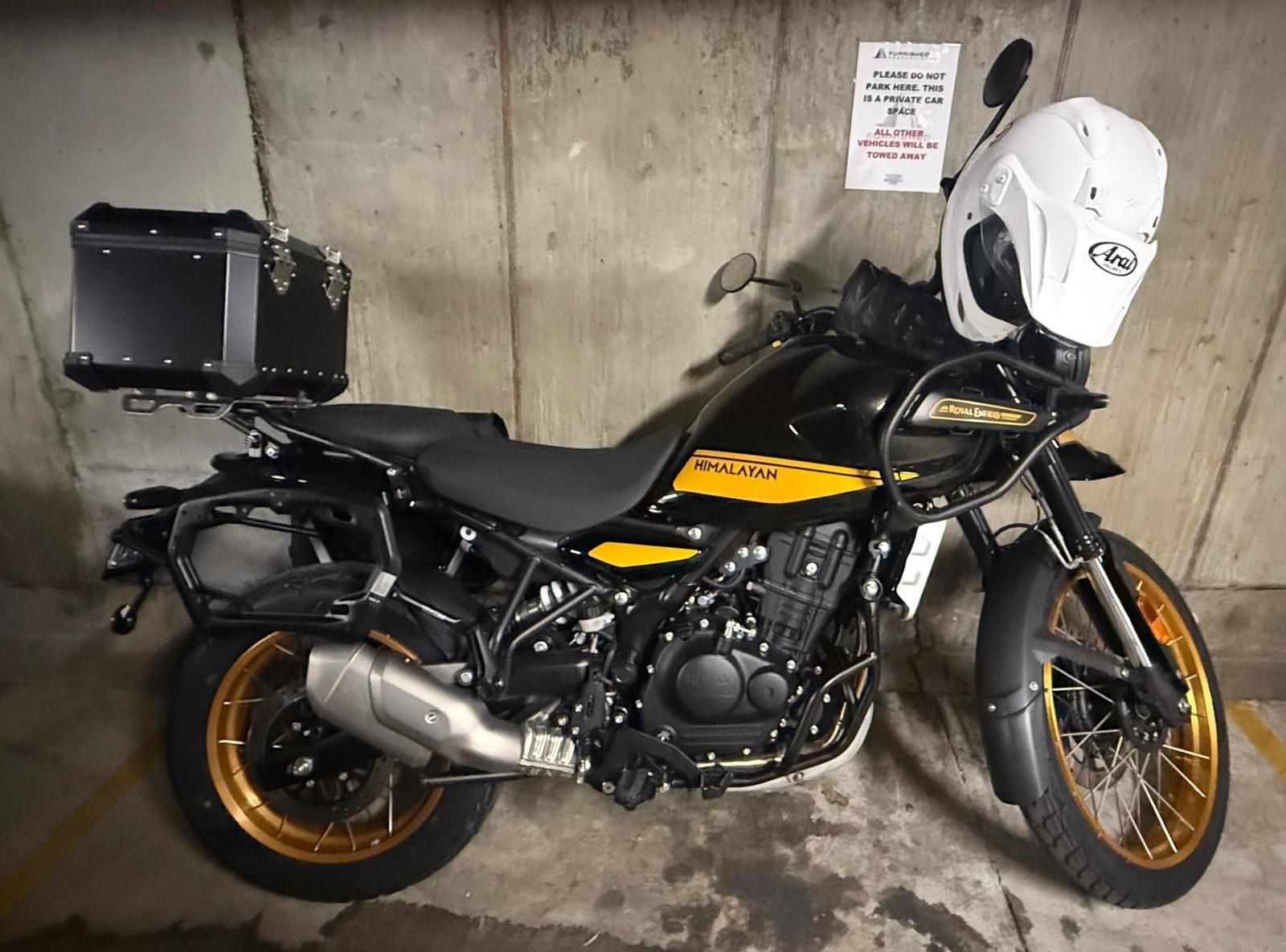
The adventure seat in its higher position. The rider section is the wider, flatter wedge ahead of the pillion step; the pillion is shorter and steeper, which suits the bike for solo touring more than two-up.
The four-hour mark, on a small adventure bike, is where the rider stops thinking about the road and starts thinking about the seat. On the way to Hill End, in October last year, four hours in I noticed I was sitting up taller than I had been. Five minutes after that I noticed I was rocking forward and back about ten centimetres in my place. I stopped at a petrol station in Lithgow, walked around the bike for a minute, swore quietly, and got back on for the last hour. That had been the OEM stock seat. A month later I had the Royal Enfield adventure seat fitted at Motociclo. Three months after that, I rode the same route — same time, same conditions, same loading — and the four-hour mark came and went. I noticed it because I was looking for it, not because the seat was telling me to. That is the difference between a stock Himalayan 450 seat and the OEM adventure seat. About an hour of comfort.
The Royal Enfield adventure seat is a factory accessory for the 2024-onwards Himalayan 450. It is a two-piece seat (rider and pillion separately removable, both keyed) with a different foam density and a different surface profile to the OEM. It is also a height-adjustable seat: the rider section can be mounted in a low position (about 805 mm seat height) or a high position (about 845 mm), with no tools beyond a 4mm hex key. The price, fitted at a dealer, is A$410 for the pair. As a bare seat it is about A$340.
I have run it on a 2025 Himalayan 450 for nine months and around eleven thousand kilometres, all of it solo riding, all of it in the higher position. This is the long-term review.
The short version
Buy it if you ride more than two hours at a time and the OEM seat has ever made you stop thinking about the road. Don’t buy it if your riding is mostly short days under two hours, or if you are on the shorter end of the height range and the higher position would put you on tip-toes. The adventure seat is the right seat upgrade for tall and average-tall riders; for shorter riders, the OEM seat in the low position or a Sargent custom is probably the better answer.
What it earns
Long-day comfort. The adventure seat is firmer than the OEM, in the way good touring seats are firmer. The OEM is plush at hour one and flattening at hour three; the adventure seat is moderate at hour one, moderate at hour four, moderate at hour six. It does not soften under load. It also does not concentrate pressure at the sit bones the way the OEM does after a few hours.
The rider area is wider and flatter. The OEM rider section narrows where it meets the tank, in a shape that suggests the designers wanted the short-rider feet-down dimension to stay reasonable. On a long ride the narrow forward section pushes your weight back onto a smaller patch of foam. The adventure seat is wider at the front, which spreads the weight forward and keeps the sit bones from taking the brunt.
The adjustable height. The adventure seat has two mounting positions for the rider half. The low position is about the same as OEM (805 mm). The high position is 40 mm taller (845 mm). At 184 cm, I prefer the high position; the bend at the knee is less acute, the standing transitions on dirt are more natural, and the sight line over the screen is cleaner. If you are 175 cm or shorter, the low position is probably right.
Surface texture. The adventure seat’s top surface has a small grip pattern that holds you in place during braking. The OEM is smoother and slightly slipperier. On hard braking the difference is real but minor.
The four-hour mark came and went. I noticed it because I was looking for it, not because the seat was telling me to.
What it costs
The price. A$410 fitted is fair money. The custom-foam alternatives (Sargent, Corbin, Saddlemen) cost A$700 and up. For most riders the OEM adventure seat is the right place to stop.
It is firmer. Riders coming from a softer touring seat may find the first hour of the adventure seat less plush. The trade is sustained comfort for initial plushness; if you are doing one-hour rides in suburbs, you may prefer the OEM.
The pillion section. Honestly, the adventure seat’s pillion section is no better than the OEM pillion. If you are a regular two-up rider, this seat is not the answer for the pillion — look at Sargent for the rear, or accept that the Himalayan 450 was not designed as a two-up touring bike.
The four-hour mark
The thing about the four-hour mark is that nobody tells you about it before you start riding longer than three hours. Below three, no seat is uncomfortable. Above five, every seat is. The four-hour mark is where the seat that came on the bike begins to feel like the seat that came on the bike, which is to say, a compromise between cost, homologation, and being all things to all riders. A dedicated touring or adventure seat is one of those compromises taken in your direction.
On the run to Hill End, with the OEM seat, I had been counting kilometres at the four-hour mark. With the adventure seat in the same position three months later, the kilometres at four hours had gone back to being just kilometres. That is the test. Pass or fail; nothing in between.
How it compares
OEM standard seat. What the bike comes with. Fine for one-to-three-hour rides. Compromised past three. If your riding is mostly short, it is fine. If your riding is mostly long, replace it.
Sargent World Sport. A$650–750 fitted, with a six-week lead time on a custom foam build for the Himalayan 450. The Sargent is the gold standard for riders who do 600-kilometre days. If your riding budget extends to it, and your riding is in the long-distance category, the Sargent will outperform the OEM adventure seat on day-three of a tour. Below day-three, marginal.
Saddlemen Adventure Track. A$580. Imported from the US. Slightly different foam profile, gel insert under the rider sit bones. Riders in the US report a comfortable seat at the cost of a slightly hot ride in summer (the gel insert holds heat). Available in Australia through Procycle.
Custom foam re-cover (local upholsterer).A$200–300 to take the OEM seat pan and have it re-foamed with a denser foam, then recovered. A real option for riders on a tighter budget. Quality depends on the upholsterer. Two-week turnaround. Worth pursuing in country towns where the upholsterer often does motorcycle saddles for local riders.
What I’d say to a Himalayan 450 owner
If you are tall (180 cm and up) and you ride more than two hours at a time, the OEM adventure seat is the right upgrade. If you are average height (175 cm) and you ride long days, also yes. If you are shorter, look at the OEM low-position adventure seat first; if that does not work, custom foam is the answer.
In the priority list of upgrades, the seat sits fairly low — you can ride a bike with the OEM seat for a long time without complaint, and the other upgrades on this list (air filter, tyres, crash protection) make a more obvious difference. The seat is the upgrade you make once you have started doing four-hour days regularly and decided you would like them to be five-hour days.
The DIY question
Trivial. Two M8 bolts release the existing seat. The new seat sits in the same brackets. The high/low position is determined by which set of mounting holes you use on the seat pan. Five minutes if you know what you are doing.
Where to buy it
Any Royal Enfield dealer in Australia, New Zealand, the UK, and Europe carries the adventure seat as a factory accessory. Often discounted in dealer build packs. North American dealers may have to special order. There is no affiliate relationship between this site and Royal Enfield. I bought my own.
What’s next
I expect to run the adventure seat for the life of the bike. After eleven thousand kilometres the foam shows almost no compression and the cover is unmarked. If anything — and I genuinely do not expect to need it — I would move to a Sargent when the Royal Enfield adventure seat finally gives up. That decision sits at least three years and another fifty thousand kilometres away.
In the meantime: if you ride a Himalayan 450 and the OEM seat has ever made you stop counting kilometres past three hours, the adventure seat is the answer. Four hundred and ten dollars. Five minutes. Get an hour of your day back.
Get the next one
Twice a month. The next verdict and the next journey land here first — photographs, and where I’m headed next.