Oxford Premium Retro — heated grips at four degrees.
The morning the OEM grips stopped being enough. NSW winter, NZ winter, and the threshold where a heated grip becomes non-optional kit. A long-term review of the Oxford Premium Retro on a Royal Enfield Himalayan 450.
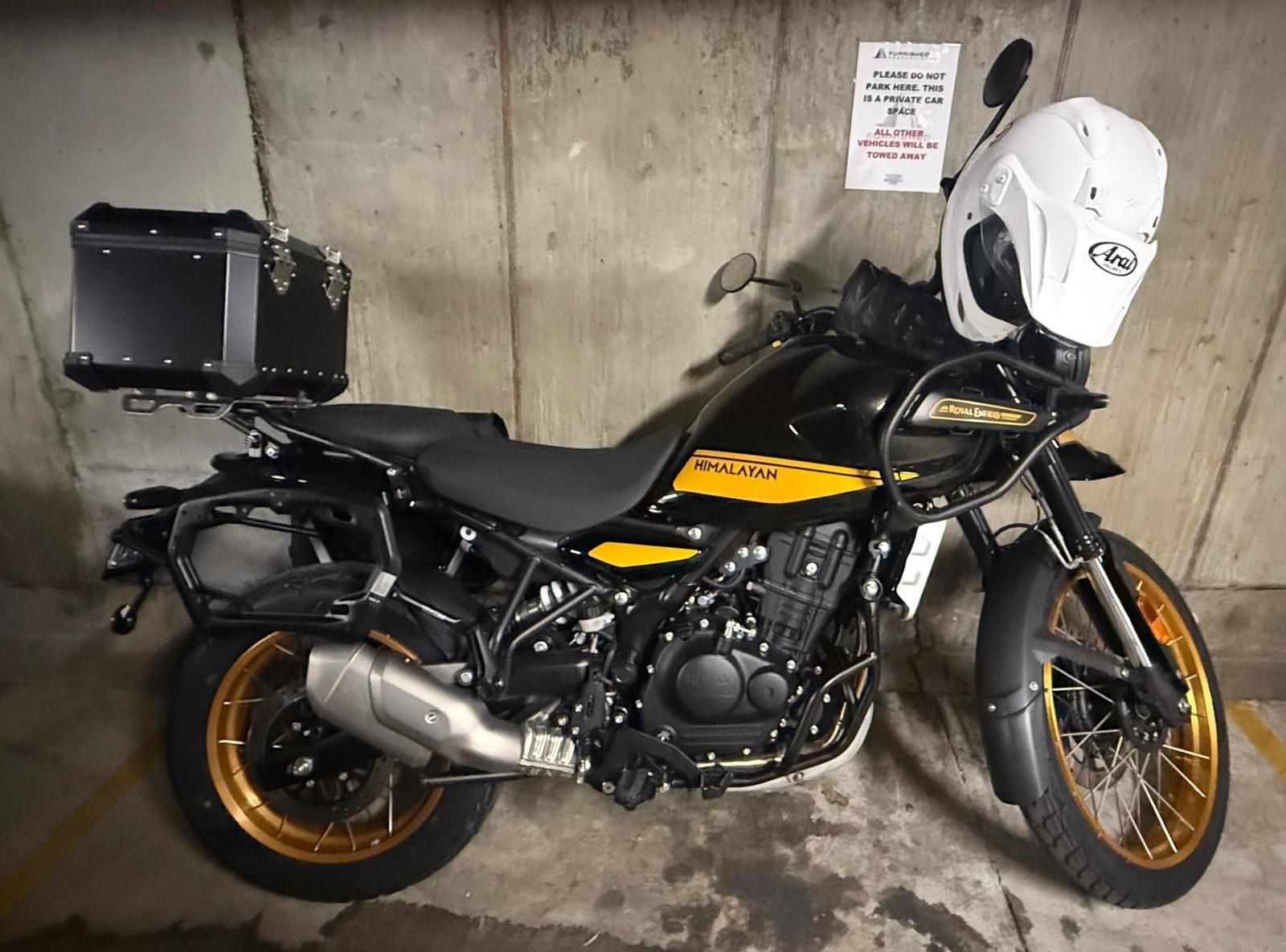
Hunter ready for a winter dawn. The Oxford grips look like the OEM grips. The small five-LED button on the left switch cluster is the only thing that gives them away.
At four degrees, with a damp wind off the Kaipara, my hands had stopped working. I had ridden out of Pahi at six in the morning to catch the light at Kaipara South Head, and twenty minutes in I was at the threshold where good winter gloves stop being enough. The fingers go pink, then white, then they go quiet. The OEM grips on the bike are excellent in summer and irrelevant in any weather where you would actually want a heated grip. I clicked the Oxford button up to level four. By the time I was at the South Head five minutes later, the hands had come back. Pink, working, warm. That is the moment the heated grip earns its keep, and on a bike that is going to be ridden year-round in two countries that have winters, that moment happens about thirty mornings a year.
The Oxford Premium Retro is a heated grip system in two parts: a pair of heated grips themselves — that look exactly like ordinary motorcycle grips, with a slightly thicker rubber outer to hide the heating element — and a small wired controller with a five-LED button that lets you set the heat level. They run off the bike’s 12-volt electrical system, draw a sensible amount of power, and have a low-voltage cutout that protects your starting battery if you forget to turn them off.
I have run them for ten months on a 2025 Royal Enfield Himalayan 450, through one NSW winter (mild, three or four mornings below five degrees) and now into one NZ winter (less mild, more frequent cold). This is the long-term review.
The short version
Buy them if you ride below ten degrees more than three mornings a year. The Oxford Premium Retro is the right model for a Himalayan 450 — cosmetically they fit the bike (matte black rubber, no chrome end caps), the controller is sensibly sized, and the heat output is enough for a four-degree morning. A cheaper model exists (the Oxford EVO) and is fine for milder climates; the Premium Retro’s extra wattage matters once you get below five.
What they earn
The hands stay working. This is the only thing they have to do, and they do it. From dead-cold, level four (the highest), the grips take about ninety seconds to feel warm and another ninety to feel hot. At hot, with winter gloves on, my hands are comfortable at temperatures down to about minus two degrees Celsius (which I have done once, on a Tasmania ridge in March). The transition from comfortable to cold to numb that good winter gloves alone allow is, with the heated grips going, transition from comfortable to comfortable.
The five-step controller. The Oxford’s controller has five LED levels rather than the cheap high/low switch some other brands use. Level one is just-warm; level five is hot. On a damp morning at ten degrees, I run level two. At five degrees, level three. At zero, level five. The granularity matters because the difference between “warm enough” and “sweating into the gloves” is a couple of levels apart, and on a two-step controller you live mostly with one or the other.
The low-voltage cutout. The controller measures battery voltage and shuts the grips off if the battery drops below a threshold. This is a feature you only ever appreciate the first time you forget to switch them off after parking the bike at a petrol station, walk away for ten minutes, and come back to a bike that still starts. On the Himalayan 450, where the battery is small relative to a touring bike, the cutout has actually saved me from a flat battery once.
Cosmetic invisibility. Look at the bars on Hunter and you would not know the grips are heated unless you looked at the small LED button on the left switch cluster. The grips look like good motorcycle grips. The Oxford Heaterz, the previous generation, had visible end caps and a slightly busy industrial look. The Premium Retro is the quieter aesthetic.
Heated grips don’t make you a winter rider. They let you keep being the rider you already are when winter shows up.
What they cost
The price. A$210 fitted at Motociclo. About A$150 if you buy the kit and install it yourself. That is on the cheaper side of the heated-grip market — cheaper than the Koso Apollo, the same as the Daytona/Hot Grips kit, more expensive than the cheap eBay generics. For what they do, fair money.
The throttle feel. Heated grips are fractionally thicker than OEM grips because of the heating element under the rubber. On the Himalayan the difference is marginal — about two millimetres of additional grip diameter on the right side. Most riders never notice. If you have very small hands, the additional thickness might be noticeable for the first hour and forgotten by the second.
The wiring. The Oxford harness includes power leads, a relay, an in-line fuse, and the controller. It is a clean install — not spaghetti — but it does add another harness to a small bike. On a 450 with the auxiliary lights, the GPS, the cruise, and the heated grips, the left-side cabling under the seat is starting to get complicated. Worth thinking about if you are doing all the upgrades.
The cold-morning math
At ten degrees, with good winter gloves and Bark Busters Storm guards breaking the wind, my hands are fine for a 90-minute ride without heat assist. At five degrees, fine for 30 minutes; uncomfortable thereafter. At zero, fine for ten minutes; unsafe after twenty — the fingers stop being able to do precision work on the brake or clutch. With the Oxfords on level three at five degrees, the same ride is comfortable indefinitely. With them on level five at zero, the same. The heated grip turns a 30-minute ride into a three-hour ride. That is the trade.
How they compare
Koso Apollo. A$280 fitted. Slightly hotter top setting, slightly thicker grip diameter, more elaborate controller. If your riding is in genuinely cold conditions (Tasmania highlands, NZ South Island, anywhere it gets to minus five), the Apollo has a real advantage. For mild-to-moderate winters the Oxford is enough.
Daytona Hot Grips. A$220 fitted. Equivalent to the Oxford in build quality and output. Cosmetic preference. I have run Daytona on a previous bike and Oxford on this one; I would buy either again. The Oxford’s controller is slightly more elegant.
OEM Royal Enfield heated grips. Available as a factory accessory in some markets. About A$280. Equivalent to the Oxford in performance. Aesthetically integrated with the bike’s switchgear. If your dealer offers them at install and you can get them as part of a build, fine. Standalone, the Oxford is cheaper and equivalent.
Cheap eBay heated grips. A$60. Two-step controller. Thin rubber. No low-voltage cutout. Will probably work for one season; will probably fail in the second. False economy if you ride year-round.
What I’d say to a Himalayan 450 owner
If you ride only in summer and only above ten degrees, you do not need heated grips. If you ride into the shoulder seasons (April-May and September-October in the southern hemisphere), they will earn their money on six or eight mornings a year. If you ride year-round, they are not optional.
The order in which I would prioritise modifications, for the third or fourth time on this site: air filter, tyres, crash protection, handguards, heated grips. They sit just behind the handguards. Both are about cold-weather comfort; both are about extending the riding season; both should be fitted together if you can.
The DIY question
Easy install if you have done it before, hour-long install if you haven’t. The OEM grips slide off (a small amount of methylated spirits and compressed air helps). The Oxfords slide on with the same trick in reverse. The harness routes from the right grip, around the bar, down the headstock, to a power tap at the battery (or the auxiliary fusebox if you have one). The controller mounts wherever you can find a flat spot on the left switch cluster.
Tools: a multimeter (to confirm power tap polarity), two cable ties, methylated spirits, compressed air, a 10mm spanner. If you are even moderately handy, this is a Saturday-morning job.
Where to buy them
In Australia, OxfordProducts.com.au is the importer. Procycle Imports and most accessory chains stock the Premium Retro. In New Zealand, MotoMail. In the UK, Oxford direct (they are a UK firm) and any accessory shop. North America: Cycle Gear and Revzilla. There is no affiliate relationship between this site and Oxford. I bought my own.
What’s next
The next New Zealand winter will properly test them. NZ winter mornings, particularly in Northland, sit around four to six degrees with high humidity — the conditions where heated grips become non-optional and where cheap heated grips fail. The Oxford Premium Retro should be in its element. I will write the second-year update when I have ridden a full NZ winter on them. Probably September 2026.
In the meantime: if you have ever ended a cold morning ride with hands that took twenty minutes to stop hurting after you got home, the Oxford Premium Retro is the answer to that morning. They will not make you a winter rider. They will let you keep being the rider you already are when winter shows up.
Get the next one
Twice a month. The next verdict and the next journey land here first — photographs, and where I’m headed next.