Baja Designs Squadron Sport — the lights that resolve the road.
Dawn out of camp before the sun shows. Dusk arrivals where the road has become the same colour as the verge. A long-term review of the Baja Designs Squadron Sport auxiliary lights on a Royal Enfield Himalayan 450.
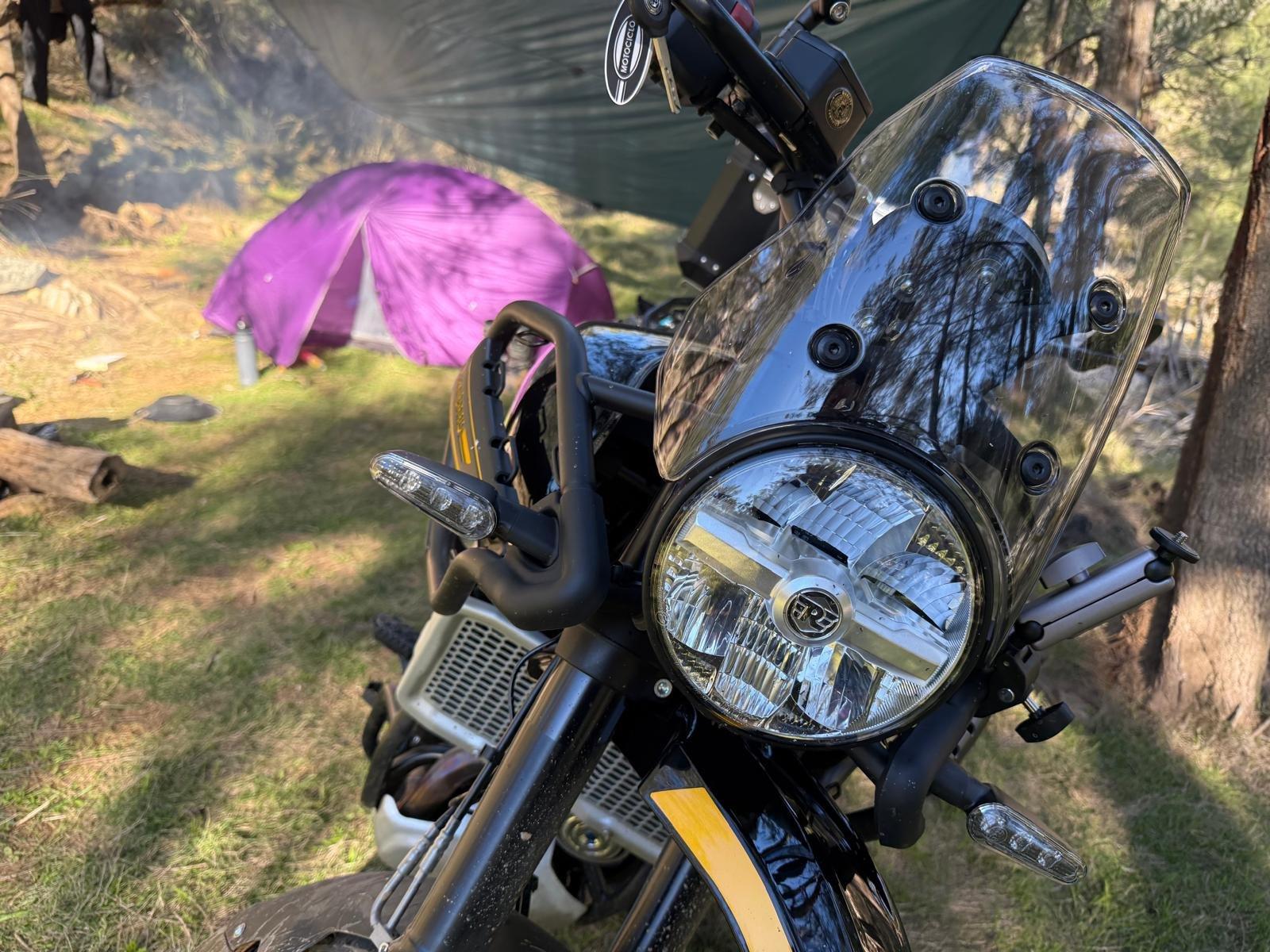
The Squadron Sports flank the OEM headlight on a small crash-bar bracket. At dawn, before the LED main beam is up to temperature, they do most of the work.
The first time I noticed what the Squadron Sports actually do was at five-fifty in the morning, leaving a Crown-land camp on a gravel road that wound through a stand of eucalypts before opening onto seal. The OEM headlight on the Himalayan 450 is fine. It is not great. At low speed in the half-dark before dawn, the OEM beam picks out the road but does not pick out the verge, and on a gravel road the verge is where the kangaroos are. With the Squadron Sports on the combo pattern, the road, the verge, and the trees on either side of the verge all became visible at once. The kangaroo was twenty metres ahead, in the long grass to my right, standing perfectly still. I saw it in time. That is what the lights bought me. That is what they are for.
The Baja Designs Squadron Sport is a small 3-inch LED auxiliary light, sold as a pair, designed for motorcycle and small-vehicle use. They are made in California by Baja Designs, the company that lights the Baja 1000 and most serious off-road vehicles in the US. The Squadron Sport is the lower-tier of the Squadron family — the mid-tier is the Squadron Pro, the upper is the LP4 Pro. For a Himalayan 450, the Sport is the right tier. The Pro and LP4 are over-engineered for what a 450’s charging system can support, and over-bright for what its mirrors can dim into the eyes of oncoming traffic.
I have run the Squadron Sport in the combo beam pattern for ten months, on a small bracket attached to the rally crash bars, on Hunter. This is the long-term review.
The short version
Buy them if you ride at dawn or dusk, in fog, in heavy rain, or in any condition where the OEM headlight has ever felt inadequate. The Squadron Sport in the combo beam pattern is the right answer for a Himalayan 450 — bright enough to do real work, not so bright that they dazzle. A$450 the pair is fair money for what they do.
What they earn
Verge visibility on country roads. The single most important thing they buy. The OEM headlight throws a wide enough beam at low speed; at 80-100 km/h the effective beam shrinks (because of the speed-relative lead time you need to brake), and the verges become dark. Kangaroos, wallabies, possums, and all the small fauna that live on Australian and New Zealand verges show up in the Squadron Sport pattern thirty metres earlier than in the OEM beam. Thirty metres is the difference between a brake and a swerve.
Dawn and dusk performance. LED main beams are cold in the first thirty seconds — the lumen output is lower until the LED reaches operating temperature. The Squadron Sports come up immediately. Click them on, the road is lit, no warm-up. On a dawn start with the bike just running, this matters.
Beam pattern. I run the combo — a wide flood for the verges and a tighter spot for the road ahead, mixed in a single optic. Baja Designs sells the Squadron Sport in driving (wider, more verge), spot (longer reach, narrower), and combo (the best of both) patterns. For motorcycle use the combo is the right answer 90 per cent of the time. The driving is for riders who mostly do dirt at lower speeds; the spot is for highway riders who want to see further down the road.
Build quality. The Squadron Sport is rated IP68. It has been rained on, washed off, run in muddy conditions in the Tarkine, and sat in twenty-eight-degree direct sun while idling at fuel stops. They have not flinched. The mounting hardware is solid; the cabling is loomed; the connectors are Deutsch.
On the gravel road, the road, the verge, and the trees became visible at once. The kangaroo was twenty metres ahead, in the long grass.
What they cost
The price. A$450 the pair. Plus another A$80 for the wiring harness with relay and switch (Baja sells the Squadron Sport ‘wiring kit’ separately; you can buy a generic relay harness for A$25, but the Baja kit is plug-and-play and worth the difference for a clean install). All in: A$530. That is real money for a pair of lights, even bright ones.
Power draw. Combined, the pair draws about 4.5 amps at 12 volts running. The Himalayan 450’s charging system is rated at 14 amps continuous, which leaves headroom for the OEM headlight, the fuel pump, the GPS, the heated grips, and the auxiliary lights all running together — on a warm day at highway speed. On a cold day, with the heated grips on high, the bars get to a moment of load that is close to the limit. I run the auxiliary lights on a switch, off when not needed, and the charging system stays in the green.
Glare to oncoming traffic. Aimed correctly, not an issue. Aimed badly, dangerous. The Baja Designs install instructions are explicit about beam alignment: aim each light slightly down and slightly outboard, with the hot-spot on the verge two metres ahead of the front wheel. Do this with a wall test before you ride at night. I have been flashed once by oncoming traffic in nine months, on a bike whose lights I had just re-aimed and not yet wall-checked. My fault. Easily fixable. Pay attention.
How they compare
Denali D2. Roughly A$400 the pair. Slightly less bright, slightly less weatherproof, slightly more compact. A defensible alternative. The Baja Designs has the better optical pattern and the cleaner wiring kit; the Denali has a slightly cleaner cosmetic profile.
Clearwater Krista LED. A$700 the pair. Brighter than necessary for a Himalayan 450, with a pre-set dimming feature that is genuinely useful on long road trips. Over-engineered for the bike at this price point. If you have a 1200-class adventure bike, look at the Clearwaters; if you have a 450, the Squadron Sport is the right tier.
Cheap eBay LED pods. A$50 the pair. The difference is in the optics. Cheap LED pods have a flood pattern that scatters light everywhere without doing much for the road; expensive LED pods have a precision optic that puts the light where it needs to be. On a country road at dawn the difference is night and day, literally. If A$450 is hard, the Denali D2 is the closest you can get without sliding into “cheap pod” territory.
The install
I had the lights fitted at Motociclo at the same time they did the rest of the accessory build — the tyres, the cruise, the GPS, and the fairing screen. The fitter mounted the Squadron Sports on a small custom bracket that piggy-backs on the rally crash bars. The wiring runs from the lights, along the top tube, into the relay harness mounted under the seat, with a switch on the left bar cluster.
Total install time, mostly because of routing the wiring cleanly: two and a half hours of workshop time. If you are doing it yourself, plan a half day. The Baja Designs harness comes pre-loomed with the relay and connectors; the bike-specific work is the bracket and the switch placement. Forum riders have detailed several different bracket designs for the Himalayan 450 specifically; the ‘crash bar clamp’ bracket from BHG (the same firm that makes the Bark Busters) is the cleanest commercial answer if you have the rally crash bars already.
What I’d say to a Himalayan 450 owner
If your riding is mostly daytime, mostly seal, mostly clear weather, you do not need auxiliary lights. The OEM headlight is fine for that. If your riding includes any of: dawn or dusk starts, country roads where animals are at the verge, fog or heavy rain, or nights you would rather not be on the bike but are, the Squadron Sport pays for itself the first time it picks out something the OEM beam would not have.
In the order I would prioritise modifications, lights are middle-of-the-pack — after air filter, tyres, crash protection, and handguards, and ahead of an aftermarket exhaust or a re-map. They are a quality-of-life upgrade that becomes a safety-of-life upgrade about once a month.
Where to buy them
In Australia, BajaDesigns.com.au is the official importer and ships nationally. Procycle Imports carries the Squadron Sport in stock. In the UK and Europe, Adventure Spec and a handful of specialist suppliers. In North America, Baja Designs direct. No affiliate relationships here. I bought my own.
What’s next
I expect to run the Squadron Sport for the life of the bike. The LED life is rated at 50,000 hours. I am, at most, three thousand hours into them. The housings are robust. The optics have not yellowed. The harness is solid.
The next lighting upgrade I am considering is a third light — a dedicated long-throw spot for when the road runs long and straight in the dark. That is a Clearwater Erica, mounted high on the fairing screen bracket, and a project for next winter rather than now. I will write about it then.
In the meantime: if you have ever come up on a kangaroo or a possum at the verge of a country road and thought, “I should have seen that earlier,” the Squadron Sport is the answer to that thought. Bolt them on. Aim them down. Forget about them until the next dawn.
Get the next one
Twice a month. The next verdict and the next journey land here first — photographs, and where I’m headed next.